
Traveling with a Bald Eagle: Behind the Scenes of Indy’s Journey to Philadelphia
When Independence, or “Indy” to her friends, arrives at an event, curiosity is never far behind. The question we hear most often is:
“What’s it like to travel with a bald eagle?”
Though getting from A to B “as the eagle flies” may sound simple, every trip Indy takes is the result of months of planning, permitting, close partnerships, and an incredible team dedicated to putting her welfare first. Here’s a look behind the scenes.
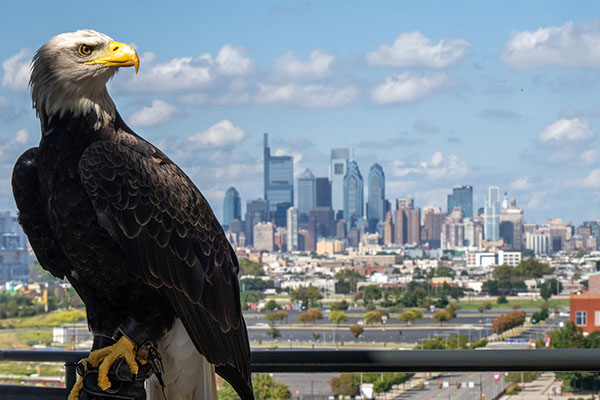
Why is Indy traveling to Philadelphia?
The Auburn University Raptor Center, a division of the College of Veterinary Medicine, is deeply honored to participate in the America 250 celebration in Philadelphia, the birthplace of our nation and the site of the America 250 Time Capsule dedication ceremony.
As our nation’s history is celebrated and preserved, we believe it is equally important to celebrate and safeguard the natural heritage that has shaped America from the beginning.
The bald eagle is woven into that story. Native to North America, the bald eagle has represented the United States for centuries, but these birds are also a testament to the power of conservation. Once facing an uncertain future, the bald eagle’s recovery stands as one of our greatest conservation success stories—a living reminder that when Americans unite behind a common purpose, we are capable of extraordinary things.
By bringing Independence to Independence Hall, we are proud to represent Auburn University, the state of Alabama, and the conservation values that will help shape America’s next 250 years.
This is an opportunity to celebrate not only our nation’s history, but also our shared responsibility to ensure its wildlife and wild places endure for generations yet to come.
What will Indy be doing at the event?
For a bird accustomed to big events, this will be one of Indy’s easier assignments. Since she won’t be participating in any flight demonstrations, her only job is to perch comfortably on the glove, help us educate about bald eagles, and, as always, look majestic for photos.
The event organizers have thoughtfully arranged a private “green room” where Indy can cool off, relax, and recharge between appearances. Even America’s national bird needs a little downtime.
What’s needed to transport a bald eagle across the country?
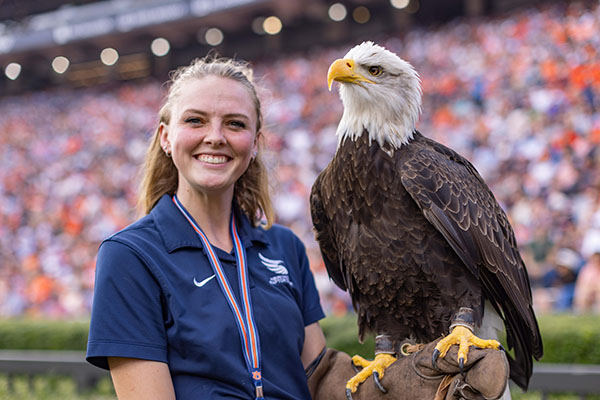
The Auburn University Raptor Center holds both state and federal permits to care for our resident ambassador birds and rehabilitation patients. Transporting a bald eagle across state lines, however, requires additional state permits, extensive coordination with both state and federal agencies, partnerships with local veterinarian offices, and strict compliance with regulations governing protected wildlife.
For this trip, we also developed a detailed travel protocol that was reviewed and approved by Auburn University’s Institutional Animal Care and Use Committee (IACUC), providing an additional layer of oversight to ensure we adhere to the highest possible standards.
Every aspect of Indy’s journey has been carefully planned with one priority in mind: her welfare. Coordinating a trip like this takes months of preparation and collaboration.
Does TSA really know a bald eagle is coming?
They certainly do. Showing up at airport security with a bald eagle isn’t something you wing.
Our team coordinates closely with TSA in advance to ensure every step of the security process is planned, often in a private screening area for Indy’s comfort.
We’re incredibly thankful for the professionalism and partnership of the TSA team at both airports, who have helped make this historic trip possible.
How do you buy plane tickets for an eagle?
Delta has been an outstanding partner throughout the planning process.
From the earliest conversations, their team worked alongside us to identify the safest and most comfortable travel arrangements for Indy while ensuring a smooth experience for everyone onboard.
We’re incredibly grateful for their collaboration and hospitality.
Why isn’t Indy flying first class?
Indy travels in a custom-built, USDA-approved carrier designed specifically for her safety and comfort. On many aircraft, first-class seats have fixed armrests that prevent her carrier from fitting securely.
The main cabin gives us the flexibility to safely secure her travel accommodations. Her carrier occupies two seats, with her handler seated beside her, while the rest of our team sits nearby.
Rest assured, her carrier still provides a first-class experience, even if it doesn’t come with the warm towel service.
Why didn’t you take Auburn’s jet?
Our friends in Auburn University’s Air Transportation Department were incredibly supportive as we explored the option of more private air transportation. Together, we looked at multiple carrier and seat configurations to see whether we could make it work.
In the end, the challenge wasn’t booking the aircraft itself. Indy’s custom travel carrier is spacious, and once it was accounted for, we couldn’t find an arrangement that accommodated both her specialized setup, our traveling crew, and all of Indy’s carrion—or, rather, carry-on luggage—while still adhering to flight regulations.
Does Indy enjoy traveling?
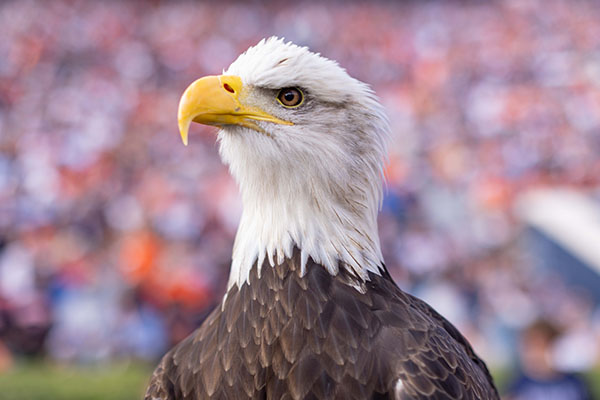
Our ambassador birds are carefully conditioned through positive reinforcement to become comfortable with many aspects of their work, including entering their travel carriers and experiencing new environments.
Throughout the trip, our experienced staff continually monitor Indy’s behavior to ensure she remains relaxed and comfortable. If she ever indicates that she’s not comfortable with an activity, we adjust our plans accordingly.
Because of that training, Indy has become a seasoned traveler, confidently navigating everything from airline cabins to hotel rooms.
Where does Indy stay overnight?
Indy travels with her own “hotel room.”
Our team brings a portable setup that includes a comfortable perch, fresh water, a protective tarp, and everything she needs to maintain her normal routine. Keeping her environment familiar helps ensure she remains comfortable throughout the trip.
There’s no need for room service, either. Indy’s carefully prepared meals travel with us, allowing her to stay on the same diet and feeding schedule she enjoys at home. We may be in Philadelphia, but for Indy, it’s just another day with her personal entourage.
We always receive permission from the hotel before bringing Indy. She’s already an ambassador bird by profession; earning Ambassador Elite is just a matter of convincing the rewards programs to recognize frequent flyers with feathers.
Why go through all this effort?
Because we believe that standing just a few feet from America’s national bird creates a connection that lasts a lifetime. Those moments inspire future scientists, veterinarians, wildlife rehabilitators, conservationists, and informed citizens.
We’ve seen it with our War Eagle Flight tradition. We’ve heard it from the cheers of children at school programs. We’ve felt it when a concerned citizen helps us return an injured eagle to the wild.
If even one person leaves Philadelphia with a greater appreciation for wildlife and a renewed commitment to conservation, then Indy has done what ambassador birds do best. She has reminded us that caring for our nation’s wild places and wildlife is one of the most patriotic things we can do for the next 250 years.