
2026 Bailey Awards honor ‘turtles on fence’ for career exceptionalism
Turtles (order Testudines) are remarkable for several reasons, with shells formed from more than 50 fused bones, toothless beaks, and gender influenced by temperature of the nest during incubation. While holding their breath for incredibly long periods of time certainly qualifies as a superpower, turtles cannot fly and are not known for being climbers.
Thus, as Dr. Kevin Clarke `88 suggested to attendees of the College of Veterinary Medicine’s 2026 Distinguished Alumni Awards Ceremony & Dinner on Friday, April 24, if a turtle is seen atop a fence post, “there’s a question that has to be answered: How did it get there? The obvious answer is that somebody helped it.”
While Clarke and two other recipients of the college’s Wilford S. Bailey Awards – Drs. Heather Gray-Edwards `11 and William DeWitt `68 – clearly benefited from helpful educators, mentors and colleagues on their respective professional journeys, each has distinguished themselves through their capacities to help others. The Bailey Awards represent the highest honor presented to Auburn veterinary alumni in recognition of their professional achievements in veterinary medicine, outstanding contributions to communities and overall advancement of animal and human health.
The awards honor the legacy of the late Wilford S. Bailey, who served Auburn in roles ranging from veterinary instructor to dean to university president over five decades. A 1942 Auburn Vet Med graduate, Bailey was the first recipient of the college’s Distinguished Alumnus Award, which was renamed in his honor in 2000. This year’s recipients reflect excellence in academia, research and private practice:
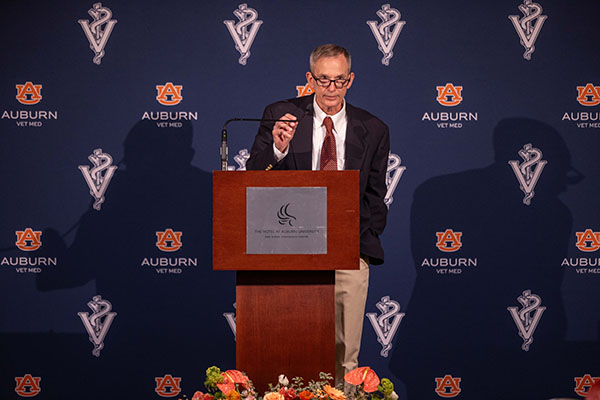
Dr. Kevin Clarke `88
When Clarke, a Kentucky native, exited an admissions interview with Auburn Vet Med faculty in 1984, he was firmly convinced the “interrogation” didn’t go so well.
“It was a very long and lonely drive back to Lexington in a Honda with no air conditioning and no radio,” he said. “I had no plan B, and I was convinced I would be continuing to deliver Domino’s pizzas at night and the Louisville Courier-Journal early in the mornings for a very, very long time.”
Not long after returning home, he opened up a letter from Auburn University to learn he had been admitted. After graduation, Clarke distinguished himself as a staff veterinarian at Grady Veterinary Hospital in Cincinnati, as a staff surgeon at Med Vet Memphis in Tennessee, and for a veterinary surgical referral practice in North Carolina. He achieved American College of Veterinary Surgeons diplomate status in 1995. His impact as a veterinary surgeon was equaled, if not exceeded, by his contributions to academia.
He served as an assistant professor of small animal surgery at Mississippi State before becoming an associate professor in the Purdue University College of Veterinary Medicine’s Department of Clinical Sciences from 1998-2005. From 2012-2022, he served as a clinical associate professor of orthopedic surgery at the University of Georgia. Through his teaching of locums, he also positively impacted Auburn veterinary students – so much so that Clarke was frequently suggested by them as a potential commencement speaker along with former basketball coach Bruce Peal.
“When I ask students where they’re from and what they want to do with their lives and how they define success, I’m always eager to hear about their dreams of the future,” Clarke said. “My reality has exceeded by expectations. I did get to be a veterinarian and, even better than that, an Auburn veterinarian.”
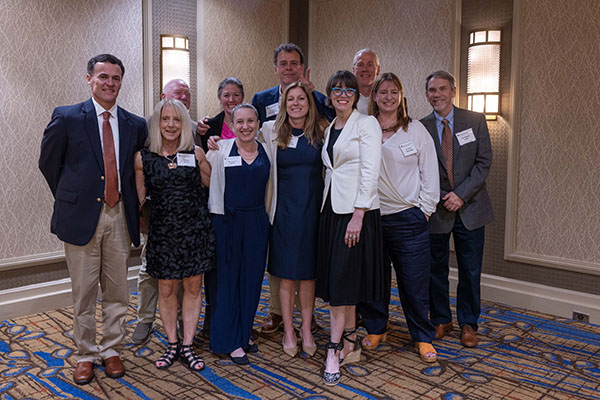
Dr. Heather Gray-Edwards `11
Gray-Edwards came to Auburn with the intention of earning a Ph.D. and a DVM and found that it presented the best of both worlds. “I learned how to be a very good critical scientist and how to be very hard on the science – both others’ and my own,” said Gray-Edwards, who earned her Ph.D. in biomedical sciences in 2007 before completing her DVM in 2011.
Her expectation for how she would apply her knowledge and skills changed a bit when she and her husband learned she was pregnant with twins while pursuing her DVM.
“The whole experience was glorious,” said Gray-Edwards, who would push a stroller through the college’s feed barn while doing weekend rounds. “As someone who gets pregnant in veterinary school, your plans change. My plans changed, and I needed a job.”
She accepted a job with the college’s Scott-Ritchey Research Center and shifted her focus from caring for cats to caring for people after meeting the parents of a child with Tay-Sachs disease. That encounter ignited a passion for exploring potential interventions for Tay-Sachs and GM1 gangliosidosis. “I went full-in on gene therapy all the way,” she said.
Gray-Edwards initially served as an adjunct assistant professor in Tufts University’s Cummings School of Veterinary Medicine before joining the University of Massachusetts as an assistant professor in the Horae Gene Therapy Center and Chan Medical School Department of Radiology. She is leading the transition to the clinic of a second-generation AAV for Tay-Sachs disease that is largely based on her groundbreaking work in a sheep model of Tay-Sachs.
“This is the most rewarding thing I ever could have asked for,” she said. “My incredible training I received from everyone [at Auburn] has allowed for the first human clinical trials for these terrible diseases.”
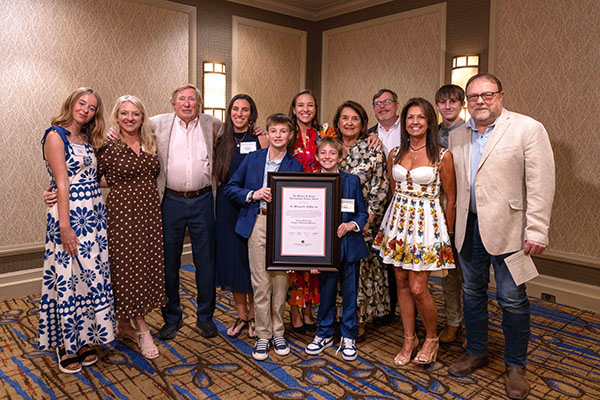
Dr. William DeWitt `68
During his time at Auburn, DeWitt learned from the late and legendary Dr. John Thomas Vaughan, who imparted advice that he still follows to this day.
“His advice to me one time was to never let the truth interfere with a good story,” DeWitt said. “When we graduated, we were told ‘A’ students researched, ‘B’ students teach and ‘C’ students practice. Here I am, I’ve been practicing for almost 60 years. That should tell you something.”
It speaks volumes about DeWitt’s passion for helping animals and people. He has owned and operated Forestdale Veterinary Clinic in Birmingham since 1970 – a singular veterinarian operating a small but successful practice that has served multiple generations of clients, in some cases.
DeWitt’s extensive professional service includes terms as president of the Alabama Veterinary Medical Association, the Alabama Academy of Veterinary Practice and the Jefferson County VMA. He earned Alabama Veterinarian of the Year honors in 1999-2000, as well as the Alabama VMA’s Distinguished Service Award.
“I’ve been doing [veterinary medicine] for close to 60 years, and I’ve been in the same building for 56,” he said. “I guess I’m hanging in there. I still enjoy it.”
Alumni