Caps off to the CVM’s Blood Bank donor canines
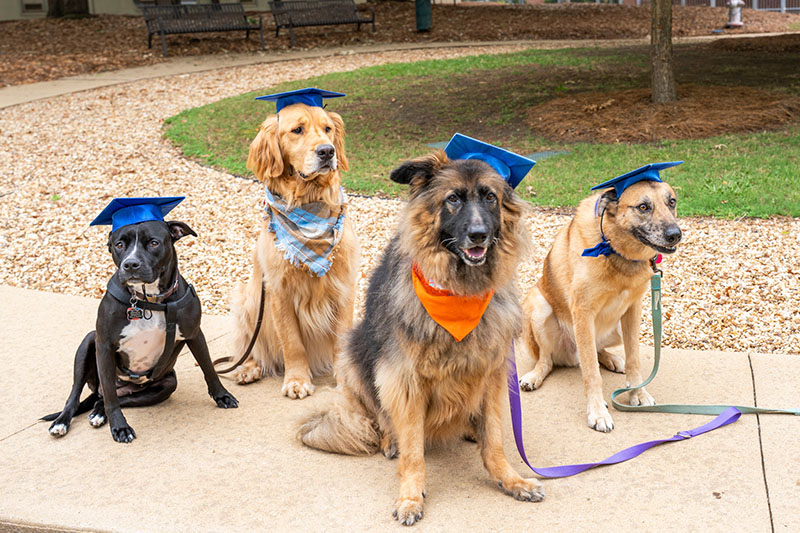
As is the case with many commencement ceremonies, the graduates really wanted to get to the after party.
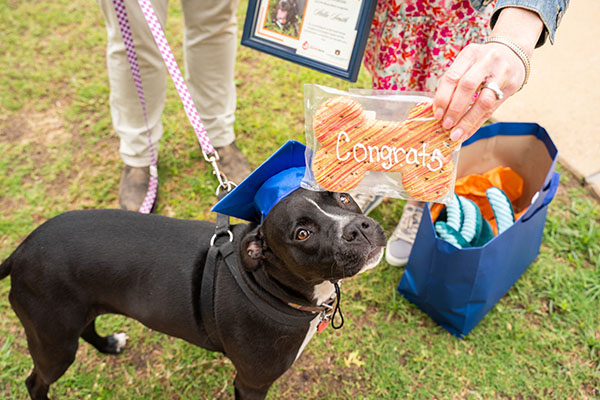
Molly tried on multiple occasions to wriggle out of the blue mortarboard atop her head, while Wiley enthusiastically sought out onlookers for hugs. Gumbo sat upright and dignified, patiently posing for photos. And Stella? Stella just wanted a cookie.
The four dogs and their human companions celebrated their graduation from the Auburn University College of Veterinary Medicine’s Blood Bank program after making life-saving gifts of whole blood, plasma and packed red blood cells over the course of the last two years.
The college’s Bailey Small Animal Teaching Hospital draws on roughly 30 donor canines for a variety of caregiving needs. Fresh and safe blood products help in the treatment of cancers, trauma, sepsis, heatstroke, immune-mediated blood diseases and some tick-borne diseases, according to Dr. Dana LeVine, professor of small animal internal medicine and Blood Bank co-coordinator.
Molly, Wiley, Stella and Gumbo each became involved with the Blood Bank through their owners, who are members of the College of Vet Med’s graduating Class of 2026. Garrett Smith brought Stella, a pitbull and lab mix, to the Blood Bank after seeing a flyer in the CVM. Since her initial donation in June 2024, she has helped 13 patients by donating more than 2.1 liters of packed red blood cells, 1.4 liters of whole blood and another 1.39 liters of plasma.
“She has a good temperament, so I thought I’d try it and see if she could help,” said Smith, a Prattville, Ala., native. “I got to meet all of the dogs she has helped and that was awesome – especially during my clinical year.”
Similarly, Giselle Payton was drawn to the Blood Bank by her desire to help other pet owners. Her dogs – Molly, a German Shepherd, and Wiley, a shepherd mix – have combined to donate more than 7.3 liters benefiting 24 patients since spring 2024.
“I didn’t know a ton about the program, but I know that I have a passion for giving back to the community,” said Payton, who is moving on to a job with a general practice urgent care veterinary clinic in Pensacola, Fla. “I thought, ‘What better way to help than by involving my pups?’”
To be considered for as a donor, a dog must be greater than 50 pounds, 1-6 years old, spayed or neutered, healthy and free of medications, current on vaccines and monthly heartworm preventatives, good-natured and able to make a two-year commitment to the program. The program maintains an equal balance between dogs that are positive and negative for the Dog Erythrocyte Antigen (DEA) 1. LeVine said dogs in the program will typically donate a 450-milliliter unit every three months but may return sooner to meet emergent needs.
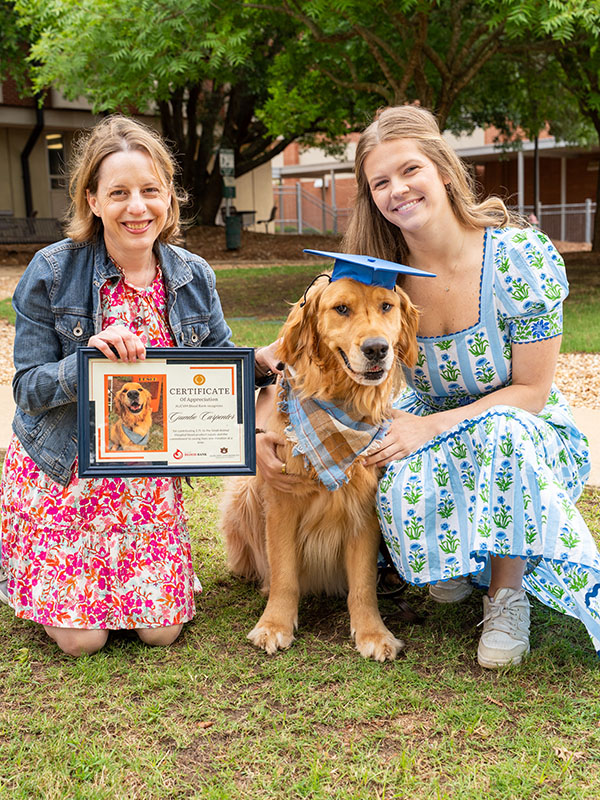
Elizabeth Carpenter, owner of the flavorfully-named golden retriever Gumbo, was surprised to learn that her four-legged friend had donated more than 2.76 liters (1.39 as plasma) and helped 12 patients since September 2024.
“It has been really cool [to see the impact] because his mom, actually in the last month, needed a blood transfusion,” said Carpenter, who is moving to South Carolina to take part in the Veterinary Emergency Group training program. “Seeing that he had done something like that for other people’s families was great to see.”
Pet owners and animal lovers can support the Blood Bank by purchasing sturdy toys from its Amazon wish list. The toys are one of the many ways the Blood Bank thanks donor dogs for their life-saving gifts.