
From Auburn to the Arctic: Veterinary medicine at minus-60
Having competed in marathons and triathlons, Dr. Mary Beth Hannon respects the interplay between proper training, nutrition and sports medicine in athletic performance. As a professor of practice in the College of Veterinary Medicine with a focus on small animal emergency medicine, Hannon has applied her clinical skills and knowledge of endurance sports to help a unique group of four-legged athletes in one of the most extreme competitive environments imaginable.
In February, Hannon served her fifth tour as a member of the veterinary team for the Yukon Quest Alaska 750 — a sled dog race that traces portions of the 1890s Klondike Gold Rush, mail delivery and transportation routes in Alaska’s interior region. With each trip, Hannon’s love and appreciation deepens for the Alaskan Huskies that power their human “mushers” and provision-laden sleds through extreme cold.
“The dogs are the most incredible athletes in the world to me,” Hannon said. “They’re just machines.”
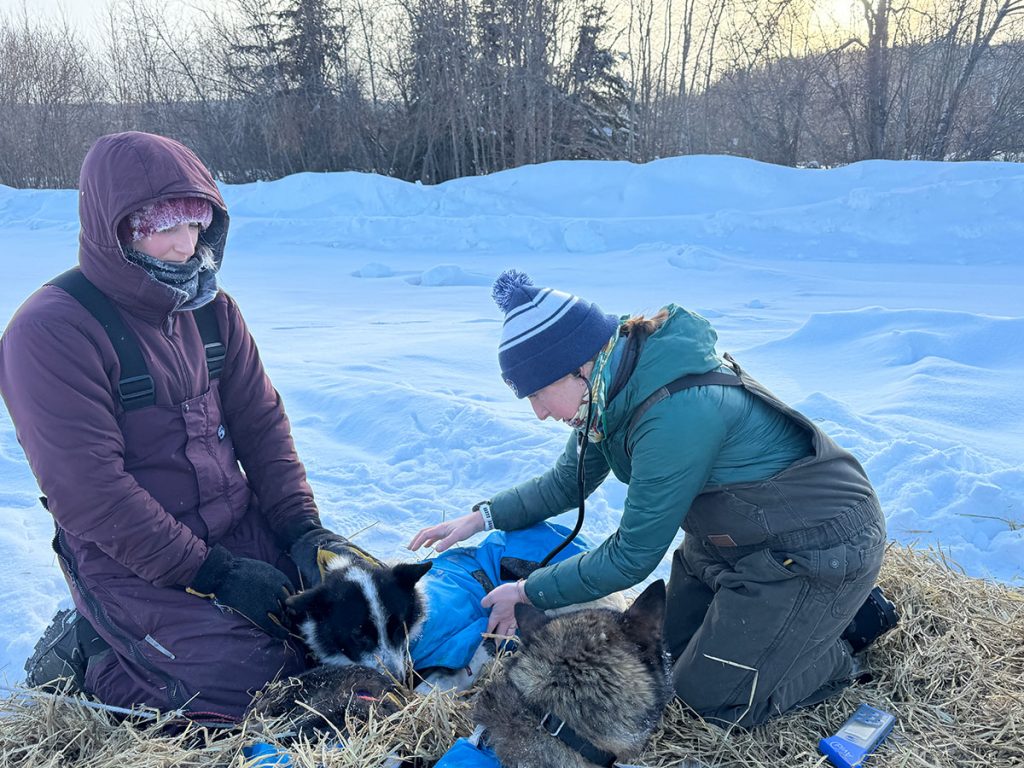
Minding and mending the machines
The machines Hannon and her fellow veterinarians care for run on copious amounts of meat and kibble. Mushers pack up to 250 pounds of equipment and food for their six- to 14-member sled teams and themselves to survive on between the race’s 13 checkpoints. Hannon said the sled dogs, most of whom weigh between 35 and 85 pounds, burn through up to 14,000 calories per day on the trailhead.
“These are elite athletes, essentially,” she said. “We just check them for any pre-existing conditions or injuries they may have gotten during training so the musher can be aware of them. The main thing we track very carefully throughout the race is their body condition.”
And there lies the most unique challenge offered by the Yukon Quest 750. As the name implies, it’s a long, grueling test over unforgiving and remote terrain. Though less known than the Iditarod, the 750-mile Yukon Quest has proven itself as the world’s toughest sled dog race during its 42-year run. Many of the Yukon Quest competitors use the race to prepare for the Iditarod, which began on March 8 in Anchorage. From the time the mushers and their teams leave the Yukon Quest starting line in Fairbanks, they’ll meet extreme and unpredictable conditions with temperatures falling as low as minus-60 degrees and high winds limiting visibility, blowing away course markers, obscuring trails with debris or blocking them altogether with massive snow drifts.
Hannon and other veterinarians shuttle between checkpoints to care for the dogs. When roads are available, they travel — and often sleep — in SUVs. From Fort Yukon (population 400), which straddles the Arctic Circle, to Circle (population 91), an old mining village with one general store, to Beaver (population 84) and Rampart (population 24), warm beds and continental breakfasts are nonexistent.
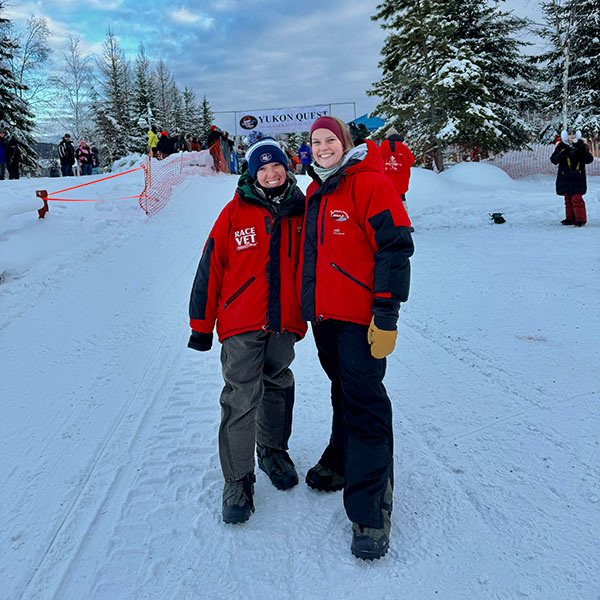
Since roads are as rare as Marriotts in the Alaskan wilderness, bush planes and snowmobiles (or snow machines, as the locals call them) are the preferred modes of transportation where SUVs can’t go. No matter the method of travel or the accommodation, Hannon and her colleagues are ready to help and heal.
“The mushers have a vet book that they carry on their sled and will present to us at every checkpoint,” said Hannon, who first became involved the Yukon Quest through a faculty mentor while studying at Cornell University. “Each dog has a page, and it’s basically a medical record that goes with them because they’re not seeing the same vets at every checkpoint.”
Among the more common injuries seen during the races are muscle and tendon strains resulting from efforts to punch through heavy snow drifts to break a trail. Even though each dog wears special booties to protect their paws from the ice and snow, wear and tear from crossing jagged terrain or frozen rivers can lead to chafing or frostbite.
It’s tough on humans, too. One of this year’s competitors snowshoed his way into a checkpoint with a frostbitten toe after trudging through deep snow for miles in 60-below weather. Two of the six teams that started this year’s race dropped out due to the brutal conditions.
While the mushers have mandatory rest periods at checkpoints, the veterinarians conduct physical examinations of the dogs and provide treatment as needed. In the case of severe injuries, dogs are dropped out of the race.
Hannon and other veterinarians on the trail travel with five sets of boxes. Each pack has a “cold box,” which includes items that aren’t temperature sensitive. Other items — injectable medications and fluids — travel in “warm boxes” that will be stored indoors. Hannon and her colleagues have basic antibiotics, pain medications, antacids, IV catheters and electrocardiogram machines at the ready. The relationship between the mushers and the veterinarians is one of mutual trust and appreciation.
“The dog care is excellent,” Hannon said. “The mushers know their animals really well. A lot of the time, the mushers will come up to us and ask, ‘Hey, what do you think about this?’ If something isn’t right, they’ll see signs of it and tell us. It’s very collaborative between the mushers and the vets, which I respect a lot.”
From frigid outhouses to Northern Lights
In between the arrival of a musher and the examination and care of their sled dogs, the veterinarians do a lot of waiting. It’s not uncommon for Yukon Quest competitors to be separated by hours or even days. This year’s first place finisher, Josi Shelley, and her 10-dog team, completed the race in nine days, nine hours and 11 minutes.
In more remote locations, a construction trailer may serve as the checkpoint headquarters. Hannon and her colleagues will spend time playing card games, reading books, taking micro-naps, stargazing, enjoying the splendor of the Northern Lights or absorbing the sort of rustic beauty of the land around them. The only constant is the cold, which makes any outdoor movement an invigorating experience.
“Using an outhouse in minus-60 is life-changing,” Hannon said. “It’s not for everyone.
“It was 73 [in Auburn] the day after I got home. That was 135 degrees warmer than where I’d been a week ago. I don’t know how the mushers do it. They’re superhuman.”
As a Yukon veteran, Hannon keeps her Arctic-grade parka, fleece-lined pants and other sub-zero gear stashed at a friend’s home in Alaska. Everything will be waiting for her when she returns.
“I love my position here [at Auburn] and the students, but sometimes it’s good to get out there and use my skill set for something a little different,” Hannon said. “I will go back [to the Yukon Quest] as long as they’ll keep having me.”
Faculty