
On the road and in the barn: The delicate balance of equine ambulatory care
Auburn veterinarians, students keep horses in harmony
Standing atop a foam block positioned next to a 1,200-pound thoroughbred, Dr. Alfredo Sanchez Londono can tell plenty about the health of the horse and the habits of its rider by sight and touch.
From the wear pattern of the saddle, Sanchez Londono, clinical professor of equine field service in Auburn University’s College of Veterinary Medicine, can tell how the rider distributes his or her weight. When riders lean to a particular side, the horse subconsciously compensates by shifting its own weight. Over time, the uneven weight distribution can result in horses developing muscular imbalance, back pain, irregular hoof wear and joint inflammation.
That’s why horse owners frequently seek out Sanchez Londono and Auburn University’s Equine Ambulatory Service. Drawing on decades of experience, Sanchez Londono can frequently head off the cascading health effects of a rider with a heavy hand on the reins or a persistent tilt in the saddle.
Using his hands, Sanchez Londono examines more than 50 vertebrae which, divided into five distinct sections, ultimately make up approximately 200 interconnected joints. On this particular morning inside a barn near Columbus, Ga., Sanchez Londono’s gentle probes, pushes and pulls frequently lead to chiropractic success – a series of occasional soft pops and signs of relaxation from the horse in his care.
Sanchez Londono’s chiropractic treatments represent one small facet of the Equine Ambulatory Service, which brings trusted veterinary care straight to the farms and barns of clients within an hour of Auburn Vet Med’s campus.
“I’ve been working on these particular horses for two years,” said Sanchez Londono, an American College of Veterinary Internal Medicine large animal diplomate, as he scanned the barn. “With a barn like this, they’re going to have horses that are jumpers or dressage. They’re going to have their own unique needs. The more you get to know them, you’ll start seeing things. They’re my usual patients. I get to know the behavior of the horse and what their specific needs are.
“We’ll talk to the trainer or rider about what is going on and what they’re doing.”
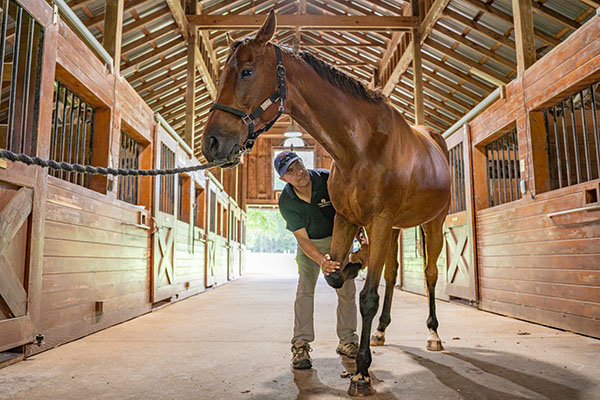
Dr. Alfredo Sanchez Londono builds trust with the animals in his care.
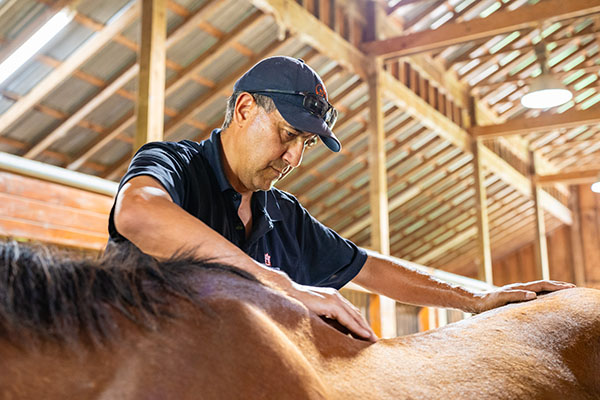
Dr. Alfredo Sanchez Londono examines more than 50 vertebrae which, divided into five sections, ultimately make up roughly 200 interconnected joints.
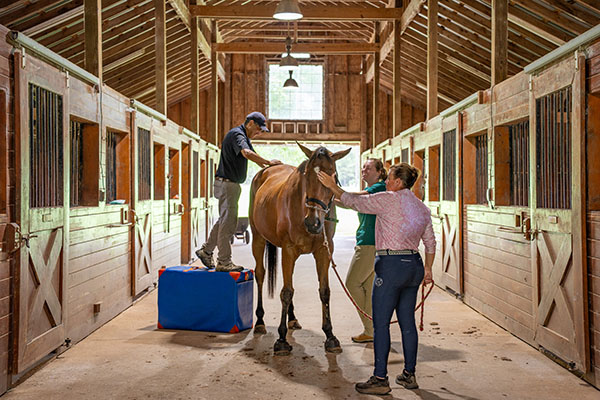
Dr. Alfredo Sanchez Londono talks to Windy Hill Farms owner Sue Beth Bunn and DVM student Deb Young as he completes a chiropractic exam.
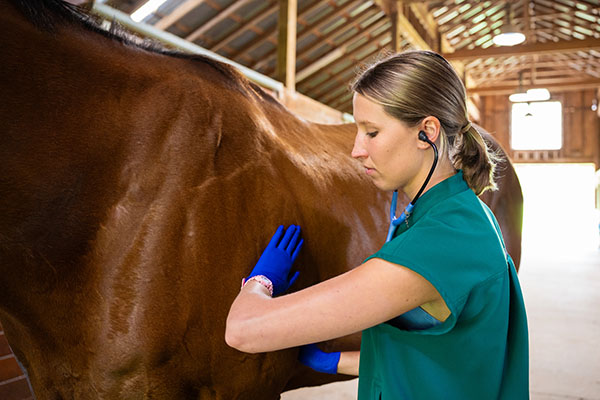
While DVM student Julia Hale plans to specialize in small animal medicine, the equine ambulatory rotation has enabled her to gain confidence with large animals.
Equine care on the move
Sanchez Londono, interns and Doctor of Veterinary Medicine students completing clinical rotations help meet a wide variety of needs, including lameness evaluations, routine wellness exams, dental care, ultrasounds, X-rays, vaccinations, chiropractic care and mesotherapy. The on-site nature of the ambulatory service appeals to horse owners because their animals receive care in a comfortable, familiar environment. Another benefit is the relationship that forms between caregiver and animal.
“One reason why I use Auburn ambulatory instead of someone local is that it’s full-service,” said Sue Beth Bunn of Windy Hill Farm, a boarding barn and riding school in Midland, Ga. “I don’t have to have more than one person come in and see my horses. The continuity of it is really important to me.
“Having Dr. Sanchez do chiropractic work is just one aspect of what he does. He can come in an assess my horses and then if it needs to be something more – an injection or lameness check over at the school – he keeps that continuity for me. The relationship he has with the horses is important to me. He’s kind with them, he’s calm with them, and they respond. I have some horses that are school horses and some that are performance horses and he takes them at their level and deals with them where they are.”
Beyond the service to clients, the site visits offer valuable experiences to Auburn DVM students who participate in two-week equine ambulatory rotations.
“For me, it’s essential,” said Deb Young, an Erie, Pa., native who is a member of Auburn’s DVM Class of 2027.
Young grew up around horses, riding in Pony Club events as a child, and plans to launch her own equine practice near her hometown after graduation.
“When we chose rotations, I put in for as many with Dr. Sanchez as I could get,” she said. “I ended up with four. He can’t get rid of me. This is where we’re going to get hands-on [experience].”
Auburn’s DVM program enables students to build confidence with small and large animal veterinary medicine. Required and selective rotations encompass small animals, food animals, equine and multi-species opportunities. Under Sanchez Londono’s guidance, the equine ambulatory rotation gives students experience in drawing blood, administering vaccines, taking X-rays and ultrasounds and assisting with dental floats.
“I like being with the students because I can listen and learn, too,” Bunn said. “How else are they going to learn if they can’t touch your horses? Plus, the doctor is always right there. I think it’s great.”
For some students, the equine ambulatory rotation offers their first close-up encounter with a horse. And, as Class of 2027 cohort member Julia Hale said, drawing blood from a 1,000-plus pound horse with a vein “like a water hose” feels different than doing so with a housecat.
“The majority of my work has been in small animal,” said Hale, a native of Marion, Ark. “It’s very, very different from small animal. Here, we don’t have a typical waiting room or exam room.”
An intensive experience
Sanchez Londono enjoys engaging students no matter their comfort level around horses or their ultimate aspirations as veterinarians.
“Over the two weeks of the rotation, little by little, we allow them to do more stuff,” he said. “This is one of the rotations where they have a lot of hands-on work with horses. They start from simple things, drawing blood, vaccines, and we get them to do ultrasounds, joint injections, dentals under our guidance. Some of them do end up going into equine practice and it’s gratifying to see that.
“I’m going to make sure that you work around the horse and that you figure out it’s not as scary as you might think it is.”
The experience may not be frightening, but it can certainly be fatiguing. After nearly three hours of chiropractic evaluations and the pushing, pulling, massaging and adjusting of limbs, necks, shoulders and backs of three progressively larger horses, Sanchez Londono glowed with perspiration. The equine chiropractor might have appreciated an adjustment from his human-focused counterpart.
“I did my fair amount of exercise today,” he said with a smile.