
Paws or claws? Uncovering veterinary ‘cattitudes’ to provide better care
Getting to know someone usually starts with the basics. What kind of movies are they into? Are they an early bird or a night owl? Or the ever-polarizing question: cats or dogs?
For ages, people have tied their identities to whether they prefer paws or claws. But what about veterinarians? Do clinicians who care for our furry friends have preferences, too?
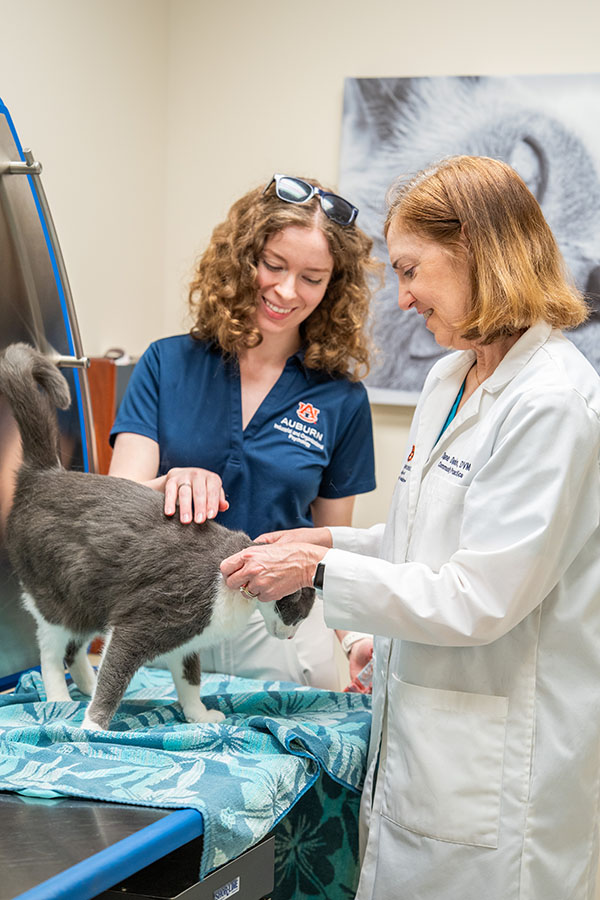
Dr. Diane Delmain, an associate clinical professor in the College of Veterinary Medicine, teamed up with CVM alum Camille Wood and College of Liberal Arts alumni Drs. Rachel Whitman Rotch and Nicole Shifrin to tackle that query. In a recently published study, they examined how veterinary professionals view cats and dogs and whether those preferences show up in their work.
The verdict? Dogs overwhelmingly came out on top.
That preference goes beyond personal taste — it has the potential to influence confidence, shape training and ultimately affect patient care.
Why look at ‘cattitudes?’
Only 40% of cats visit a veterinarian each year compared to 80% of dogs. On top of that, yearly veterinary spending is lower for cats.
Those numbers concern Delmain, who holds two advanced certifications in feline care and spent years in private feline practice. She emphasized that routine visits are just as critical for cats as they are for dogs.
“The issue with cats is they don’t like to tell us when they’re sick,” Delmain said. “By the time they come in, they’re often really sick, which makes it harder and more expensive to help them.”
The gap in veterinary visits could be attributed to several factors. Cats are often harder to transport, and negative clinic experiences can cause stress on cats and their caretakers. Cost and access to care can pose additional barriers.
But Delmain suspected there might be another factor at play. She wondered whether veterinarians’ attitudes toward cats — and the level of education and exposure they receive — could influence not only preferences, but the quality of feline care.
That question resonated with Wood and former DVM student Kendall Mitchell, who suspected that many of their classmates and professors leaned toward dogs. They brought the idea to Delmain, who shared the study idea with Auburn’s Industrial/Organizational Psychology program and connected with Rotch and Shifrin.
Herding cats (or data)
Together, the interdisciplinary team set out to test their hypothesis that differences in experience, education and confidence might help explain why cats so often fall behind dogs in veterinary care. They developed a survey to evaluate veterinarians’ attitudes toward both cats and dogs in five areas: confidence, preference, personal experience, professional experience and education.
With 287 responses from faculty, staff and veterinary students, a clear pattern emerged.
“In every single category that we looked at, cats were rated lower than their dog counterparts,” Rotch said.
Allergies played a role. Expectedly, people with cat allergies had a lower preference for cats. Education and experience played an even bigger role. As experience with cats rose, overall confidence increased, but the opposite was true with dogs. Delmain suspected that could be because of the difference in cues between the species.
“A cat is never going to lie to you,” Delmain said. “Once you learn to read their body language, working with them is actually pretty straightforward. But dogs can change their mind pretty quickly.”
Changing ‘cattitudes’
While the study results did not surprise Delmain, putting data behind her observations marked an important step toward improving feline care.
“The survey made people think about feelings or biases they didn’t really realize they had,” Delmain said. “Just recognizing that can be helpful in making more positive impacts.”
Beyond its findings, the study provides a practical tool that veterinary schools and clinics can use to measure “cattitudes” before and after implementing feline-friendly initiatives to help determine whether changes in training and exposure are making a difference.
Since the study was administered in 2019, Delmain has led the charge to increase exposure and education for DVM students in the College of Veterinary Medicine. Students now have access to hands-on labs with cats before they enter their fourth year. All CVM students and employees now have complimentary access to online training through the Feline Veterinary Medical Association, which is included in nursing staff onboarding.
For Delmain, improving feline care isn’t about choosing sides. It’s about making sure every patient, regardless of species, receives care rooted in confidence, compassion and understanding.
Auburn University Veterinary Clinic