
Precision, practice and 1,400-pound patients: CVM palpation team builds on championship legacy
By Troy Johnson
As expected, members of one of Auburn University’s most prolific championship-winning teams devote considerable time to their craft. They often awaken when it’s still dark outside and train through the thick summer humidity and numbing winter chill.
Like their counterparts in intercollegiate sports, they aren’t afraid to get dirty in pursuit of excellence. A few key factors differentiate these Auburn competitors from their peers in football, basketball, baseball or gymnastics, however.
First, their arena is, quite literally, a barn. Secondly, winning largely depends on a competitor’s ability to carefully insert a lubricated and gloved hand and arm into the rectum of a 1,200-plus pound cow to accurately diagnose pregnancy, gestational age, ovarian structures and reproductive tract health.
Bovine veterinary medicine can be a messy job, but somebody has to do it since dairy and beef cattle help feed the nation.
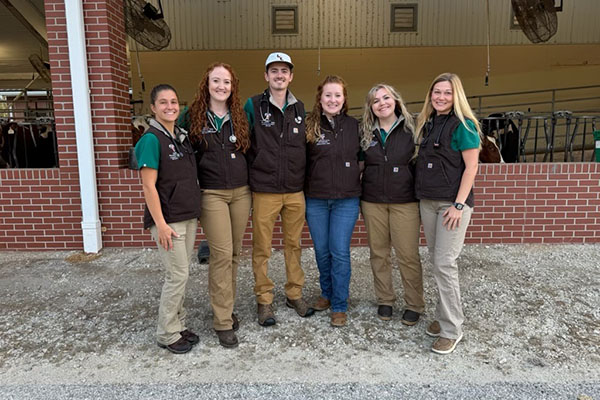
During the recent Student American Veterinary Medical Association (SAVMA) Symposium at North Carolina State University, a team of five third-year Auburn University Doctor of Veterinary Medicine (DVM) students captured the Bovine Palpation Competition title for the 13th time – the most national championships of any veterinary program.
“The past year has been a rollercoaster – long days of preparation, early mornings in the barn, and balancing everything on top of the demands of school,” said J.W. Cox, a third-year DVM student from Flemingsburg, Ky., who finished second in the individual competition. “Sitting there as they announced the top teams was a moment I’ll never forget, and seeing all of that work come together and pay off was incredibly rewarding, especially knowing how much time, effort and dedication every one of us put in.”
Auburn’s team included third-year DVM students Gabby Davis (Jacksonville, Ala.), LeeAnn Jones (Loretto, Ky.), Katja Pietrass (Kingman, Ariz.) and Logan Woodley (Thorsby, Ala.). Each of the team members credits their coach, Dr. Jessica Rush, assistant clinical professor of Food & Fiber Animal Services in the College of Vet Med, with helping them unlock their full potential. The team shared news of their win on March 14 in Raleigh with Rush via FaceTime.
“It was an especially meaningful moment to share with Dr. Rush,” Davis said. “Coming into this, I had very limited clinical experience with large animals, so being on the team allowed me to grow in ways I hadn’t experienced before.”
Developing a feel for bovine health
For the uninitiated, veterinary “palpation” refers to a diagnostic technique involving the use of hands or fingers to feel, examine and evaluate an animal’s tissues, organs and structures to detect pregnancy, abnormalities or pain. Palpation enables a theriogenologist (veterinarian with specialized training in reproductive health) to identify the cervix and uterus through the rectal wall, diagnose pregnancy (as early as 30-35 days) and identify potential uterine health issues.
At the SAVMA, each palpation team enters up to five students (four competitors, plus an alternate). The competition begins with a 50-question written examination, with the top 10 teams moving on to a lab practicum testing involving equipment, cadaver reproductive tracts and diagnostic images. From there, the top five teams each designate two students to represent them in the live palpation portion. Each student evaluates five cows in various stages of gestation, with accuracy and grasp of technical skill determining final rankings.
“The most challenging aspect of this competition is the unknown,” Pietrass said. “There is no ‘study guide.’ Everything reproduction-related is fair game in this three-part competition. Consequently, teams must be absolutely proficient in any number of reproductive topics to advance to the next round and avoid elimination.”
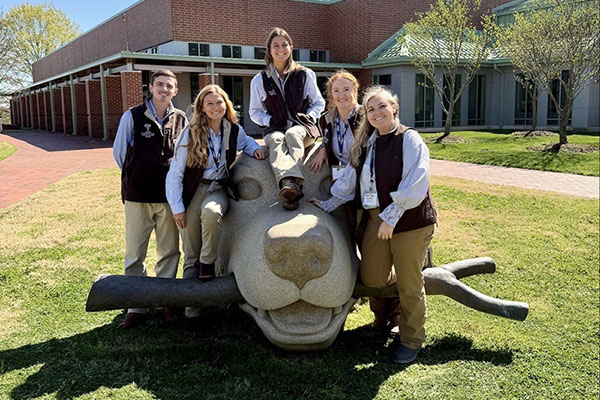
Building on a proud tradition
Faculty mentorship represents a key component in developing the absolute proficiency Pietrass described. While DVM students learn from the college’s food animal faculty through lectures, the bulk of the palpation team’s preparation happens during twice-a-week sessions with Rush. To earn a place on the team, students complete a written examination on bovine reproduction, and the five highest-scoring individuals are selected.
“For the past six months, we’ve dedicated ourselves to early mornings before classes, studying reproductive topics and practicing palpation,” Woodley said. “It was an unbelievable feeling to see all of our hard work finally pay off and to have the opportunity to represent the AUCVM. This year has not been easy, but being part of the palpation team – and forming friendships that will last a lifetime – has made it truly meaningful.”
Receiving a weekend FaceTime call from a celebratory palpation team was a particularly moving experience for Rush, who began coaching the palpation team in 2022 following the retirement of her friend and mentor, the late Dr. Julie Gard Schnuelle.
“Julie built an extraordinary legacy with this team,” Rush said. “Since stepping into this role, our teams have consistently placed within the top three or four, but this year marks the first time we have earned first place. Their success is a milestone for the students and a meaningful continuation of the foundation Julie established.”