
Roots in horse capital inspire Auburn DVM student

Growing up as the son of a horse trainer in a community known as the Horse Capital of the World, there was never really any question about Diego Figueroa’s preferred career path.
In and around Figueroa’s hometown of Ocala, Florida, more than 1,200 horse farms feature over 50 breeds. While Marion County’s sprawling green pastures are known for producing thoroughbreds, including six Kentucky Derby winners and 26 Breeders’ Cup champions, Figueroa focused on a breed descended from Andalusian, Spanish Barb and Spanish Jennet horses imported by Christopher Columbus over 500 years ago.
“I grew up showing, training and breeding Paso Fino horses as my dad was a Paso Fino horse trainer,” Figueroa said. “That led me to my passion for horses and becoming an equine veterinarian.”
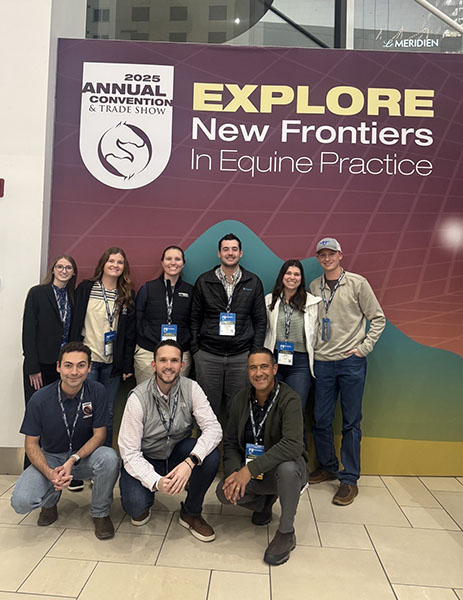
Figueroa, a third-year student in the Auburn University College of Veterinary Medicine’s Doctor of Veterinary Medicine (DVM) program, is well on his way to achieving his goal. He was one of 10 veterinary students recognized as 2025 Zoetis Foundation Scholarship recipients at the American Association of Equine Practitioners (AAEP) 71st Annual Convention in Denver on December 7.
Administered by The Foundation for the Horse, the $10,000 scholarships recognize outstanding veterinary students from colleges in the U.S., Canada and West Indies for their academic excellence, leadership in AAEP student chapters and commitment to long-term careers in equine practice.
While immediate family planted the seed for Figueroa’s initial interest in all things equine, the Auburn family may have had a hand in helping define a potential career avenue. Figueroa remembers taking a field trip to Peterson Smith Equine Hospital, a national equine care leader based in Ocala. One of the co-founders happens to be Dr. Johnny Mac Smith, who earned his DVM from Auburn in 1976.
“My dad had a 3-month-old filly in the hospital at the time,” Figueroa said. “After witnessing veterinarians’ work on my dad’s filly and taking in the rest of the practice, I knew I wanted to become an equine veterinarian.”
While completing a bachelor’s degree in biology at Florida State University, Figueroa focused on Auburn as a potential destination for a DVM. The opportunity to gain experience through the John Thomas Vaughan Large Animal Teaching Hospital, which handled more than 10,000 large animal and 1,704 field service cases in 2024, was too good to pass up. Since arriving at Auburn, Figueroa has also found faculty mentors who are invested in his professional success.
“I really appreciated the amount of exposure and case load the large animal side of the teaching hospital receives,” Figueroa said. “Being able to gain as many hands-on opportunities as possible and exposure to different cases was very important to me. I am thrilled and blessed to be at Auburn, as it was my number one choice for veterinary school.
“Dr. Alfredo Sanchez (associate clinical professor, equine field service) has been a great mentor to me since my first year. He has led me to many networking opportunities and guided me in making externship and internship decisions. His motivation and drive to provide the best opportunities for us, equine students, are like no other and do not go unnoticed. I know Dr. Sanchez will be someone I can count on after vet school.”
Since arriving at Auburn, Figueroa has also benefited from his involvement in AAEP. Figueroa has served as president of Auburn’s AAEP student chapter and said attending the national conference offers essential networking and professional development.
“As president, I consistently communicate with veterinarians, pharmaceutical reps and the college faculty to organize lunch meetings and wet labs for the student chapter,” he said. “As a current veterinary student 110% sure about going into equine medicine, attending the AAEP Convention is an experience like no other. It is a five-day event packed with incredible learning experiences and unlimited networking opportunities centered on equine vet med. Every equine-focused student should attend the AAEP convention while in school if possible.”
Figueroa will have a wide assortment of potential career pathways in equine medicine. The U.S. has long faced a shortage of large animal veterinarians, according to the AAEP, with approximately 1.3% of new veterinary graduates entering equine practice immediately and another 4.5% seeking additional training through equine internships.
After completing his DVM, Figueroa plans to complete a year-long internship before becoming a general practice ambulatory veterinarian with a focus on sports medicine, reproduction and sales. He also plans to pursue certification with the International Society of Equine Locomotor Pathology (ISELP) and in equine chiropractic and acupuncture.
“Equine medicine is a very rewarding field, and no two days are the same,” Figueroa said. “Given the [equine vet] shortage, I would tell a future veterinary student that this is the opportune moment to forge their own path in equine medicine. … Seize the moment and go all-in.”
Students