
Tiny puppy, big heart: Blondie’s second chance receives boost from Auburn University donors
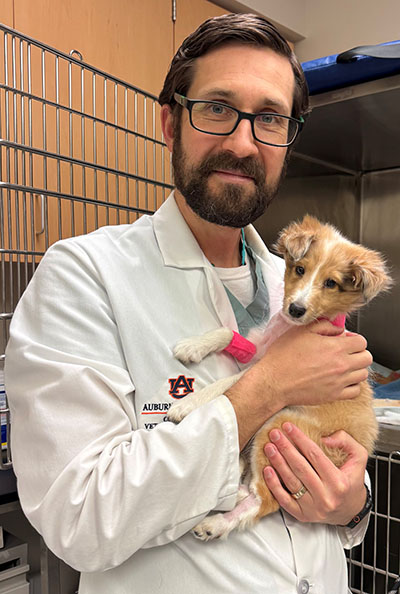
Blondie, a 2-month-old Shetland Sheepdog puppy, recently came to Auburn University’s Bailey Small Animal Teaching Hospital with a common but serious congenital heart defect — patent ductus arteriosus (PDA).
If left untreated, the condition can significantly shorten a dog’s lifespan. Thanks to the work of the College of Veterinary Medicine’s Cardiology Service team and the generosity of Auburn University Tiger Giving Day donors, Blondie should live a long, healthy and happy life.
During Auburn’s 24-hour Fall 2025 Tiger Giving Day, 288 individuals collectively raised more than $27,000 to help offset costs associated with cardiac devices for puppies and kittens born with congenital heart defects.
“Unfortunately, dogs with PDA may not even live months or years of age,” said Dr. Randolph Winter, associate professor of cardiology in the Department of Clinical Sciences. “We see some with PDA develop heart failure as soon as three months of age. But after this procedure, Blondie now has a normal heart and will live a long life.”
For Blondie and other dogs born with PDA, the condition results from a specific blood vessel – the ductus arteriosus – not closing after birth. The blood vessel connects the aorta and pulmonary artery in fetal dogs, allowing blood to bypass the non-functioning lungs. When it remains open, oxygenated blood flows back into the lungs instead of circulating throughout the body.
The condition most commonly affects small and toy breeds, including Shelties, Cocker Spaniels, Bichon Frises, Pomeranians, miniature and toy Poodles and Chihuahuas, among others. Winter said dogs with congenital heart defects typically display loud heart murmurs detectable by veterinarians during examinations or puppy vaccine visits.
“At home, dogs with congenital heart defects may show exercise intolerance, weakness, low energy or even breathing difficulties,” he said.
Expert care, generous donors work wonders
In Blondie’s case, the surgical team accessed a blood vessel under the skin in her neck “without even a skin incision,” Winter said.
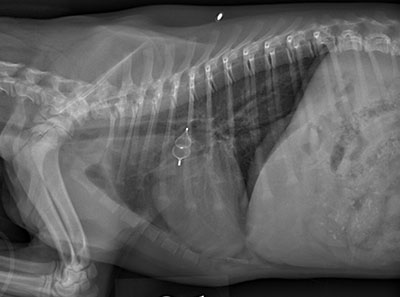
From there, the team moved special catheters through her heart and into her PDA to place an occlusion device. The occlusion device, a tiny implant, permanently plugs the abnormal vessel and prevents heart failure. The Bailey Small Animal Teaching Hospital maintains an inventory of several different types of occlusion devices that can be deployed to fit the size and type of PDA in its patients.
“We observed as soon as we placed it that we had already completely corrected her PDA,” Winter said.
While Winter and the Cardiology Service team achieved life-saving results for Blondie, Tiger Giving Day donors offered a significant cost-saving resource for her owner. PDA surgery has a high success rate, but pet owners can typically expect to pay several thousand dollars for the peace of mind it provides. Winter said the selflessness of Tiger Giving Day donors has already removed a significant financial burden for several cat and dog owners.
“The generosity that those nearly 300 kind individuals showed us here at the Auburn University Cardiology Service is just amazing,” Winter said. “We were able to help so many puppies and kittens with their donations and all of our patients – and their families – appreciate it so much.”
Individuals who are interested in supporting the Cardiology Service team’s efforts can do so by visiting the Auburn University Foundation page. Auburn University’s 2026 Tiger Giving Day is set for Wednesday, March 25.
Bailey Small Animal Teaching Hospital