Trusted treatment: inside the life-saving care of K9 Dredd
By Cynthia Williford Bean
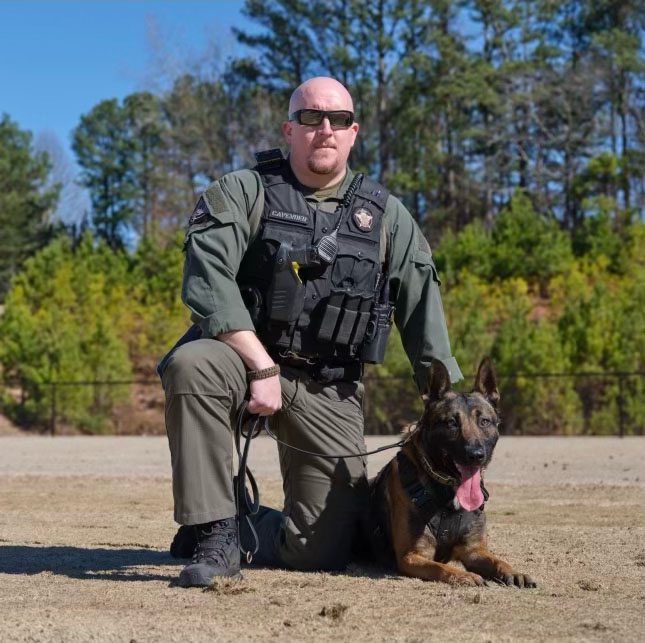
K9 Dredd and Deputy Sheriff Levi Cavender spent the last three years building trust and learning each other’s cues.
That connection is vital when tracking escaped inmates in the field. It’s also how Cavender immediately knew something was wrong.
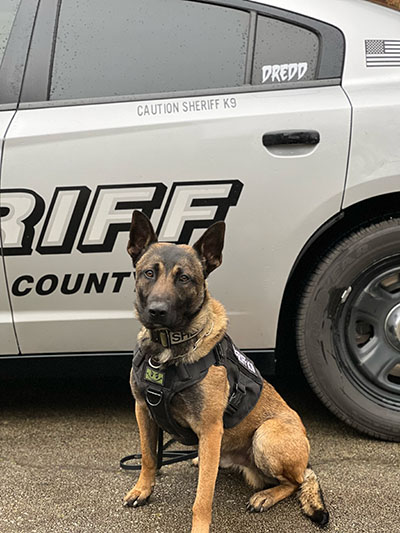
Cavender heard Dredd cough for the first time in mid-December after a tracking mission through the woods with their team at the Carroll County Sheriff’s Office in Georgia. By the end of their next shift, Dredd — a driven, energetic 70-pound Belgian Malinois — was lethargic.
Cavender took Dredd to their local veterinarian, who suspected Dredd had aspiration pneumonia caused by inhaling water or food. Two rounds of antibiotics later, Dredd still hadn’t improved. When the vet referred him to the emergency room at the Auburn University College of Veterinary Medicine’s Bailey Small Animal Teaching Hospital, Cavender feared the worst.
“It was definitely scary,” Cavender said. “He works for the department, but he is my dog. I wouldn’t trade him for anybody.”
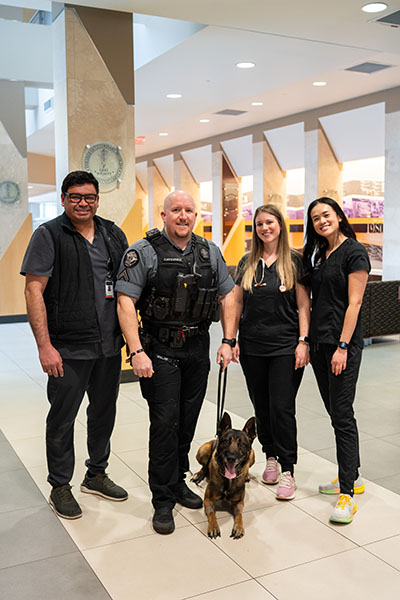
When they arrived at the hospital, Dr. George Munguia, assistant clinical professor of emergency and critical care, reviewed Dredd’s history and assessed his condition. Since Dredd was stable, Munguia scheduled a follow-up appointment and advised Cavender to monitor Dredd closely for signs of decline.
A week later, Dredd’s lethargy returned and he had lost his appetite. After he coughed up blood, Cavender reached out to Munguia, who advised him to bring Dredd back to Auburn.
Dr. Agnes Ng, an emergency and critical care resident in the ER, admitted Dredd. While Cavender waited anxiously in the lobby, Ng enlisted Auburn’s multidisciplinary team for diagnostics, starting with X-rays and a CT scan.
The CT showed that the lower part of one of Dredd’s lungs was filled with pus and that there was an obstruction in his GI tract. So, the team prepped Dredd for a procedure using a scope with a camera to collect samples of the fluid in his lower airways to help guide treatment.
During the procedure, they discovered something unexpected: a small object lodged in the affected lung.
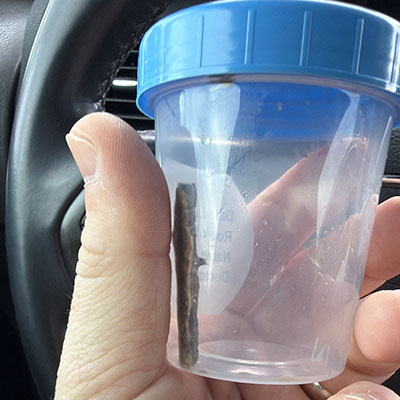
They removed what ended up being a two-inch stick that had made it into Dredd’s airways. With the stick removed, they flushed out the pus and moved on to the obstruction in his intestines. Fortunately for Dredd, the blockage turned out to be a piece of chicken Dredd had swallowed whole that same morning.
As he woke up from anesthesia, Dredd struggled to keep his oxygen levels stable. To get those levels back to normal, they placed Dredd on a high-flow oxygen unit overnight, which delivers a higher concentration and flow of oxygen than a standard oxygen cage.
“In the past, dogs in Dredd’s condition would’ve needed a mechanical ventilator,” Munguia said. “Nowadays, we have high-flow oxygen therapy that allows us to deliver up to 100% oxygen directly into the nostrils.”
Under Emergency and Critical Care Resident Dr. Christelle Sasselli’s care, they were able to wean his oxygen levels down to 70% the next morning. He was breathing more comfortably on his own within 24 hours, which Sasselli said was “fantastic for a dog in his state.” By Sunday, Cavender was able to bring Dredd home with strict orders to rest for a couple weeks during recovery.
Throughout the process, Cavender remained close, staying in the hospital lobby the first night until Dredd made it out of surgery then bunking at a nearby hotel until his release on Sunday.
“All of the staff were really informative and helpful,” Cavender said. “They trusted what I had to say, kept me in the loop and gave me in-depth explanations. I think if I had taken him anywhere else, there would’ve been a different outcome.”
For Munguia, Dredd’s case showcased the multifaceted care the hospital provides its patients.
“We had emergency, diagnostic imaging, internal medicine, soft-tissue surgery and critical care involved,” Munguia said. “I think that exemplifies the collegiality that we have at Auburn and how we made it work.”
At his most recent check-up, Dredd’s local vet deemed his lungs “pristine,” and Cavender said he’s showing it.
“It turned around, and he’s back to normal Dredd,” Cavender said. “He’s a 70-pound Malinois in a house with an 8-year-old and a 16-year-old that want to ride him like a horse, and he’s all about it.”