
Veterinary students gain hands-on experience at Atlanta outreach event
For some pet owners, the biggest obstacles to veterinary care aren’t medical. A group of Auburn veterinary students recently saw firsthand how breaking down barriers like cost, access and the fear of judgment can open doors for both pets and their humans.
Thirty-one Auburn University veterinary students spent a Saturday in early April providing cost-free care for pet owners in Fulton County, Ga. Through a partnership with LifeLine Animal Project — an Atlanta nonprofit that seeks to improve access to pet care — students had a chance to step out of the classroom and into practice.
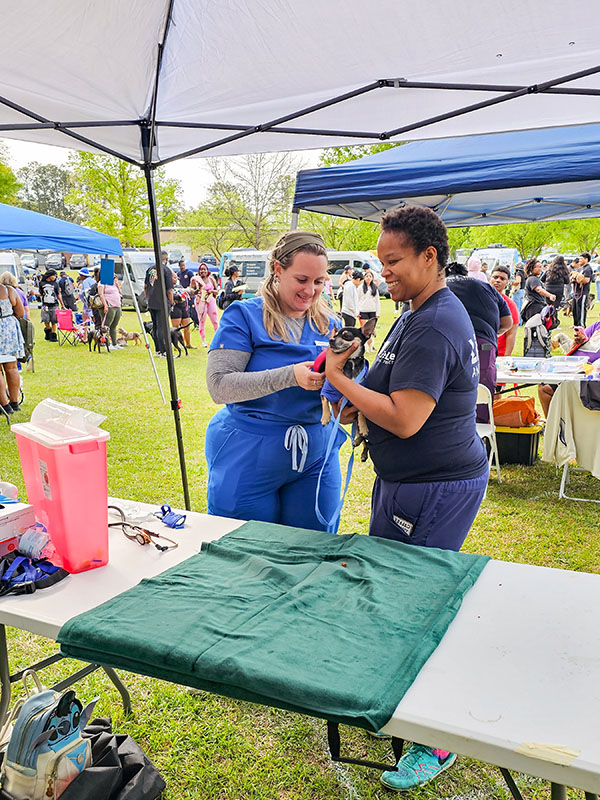
The second of its kind this year, LifeLine’s Healthy Pets events bring pet care and resources directly to communities with little-to-no access to them. Through the partnership, the College of Veterinary Medicine helps expand LifeLine’s capacity to serve animals in need while providing students with valuable experience in high-volume shelter and community medicine.
“The partnership between LifeLine Animal Project and AUCVM is incredibly valuable for everyone involved,” said Andrea Peterson, LifeLine’s chief operating officer. “Overall, it strengthens the connection between veterinary education and community-based animal welfare, which benefits both the pets and the people who love them.”
Students were divided into stations where they were paired with licensed veterinarians to assist with the full range of patient care. From handling intakes, microchips and vaccinations, students applied their clinical knowledge while practicing compassion and education.
Second-year veterinary students Sarah Daniels and Morgan Powell both had experience with community clinics, but neither had seen the volume of patients that turned out for Healthy Pets.
A total of 1,251 pets received care at the event, ranging in age from new litters of puppies and kittens to, as Powell said, “the oldest French bulldog ever.” The team of veterinarians, veterinary technicians and Auburn Vet Med students administered 1,007 rabies vaccines, 1,034 distemper vaccines and 544 microchips and handed out 821 vouchers for free spay/neuter appointments.
Powell was first exposed to shelter medicine as an undergraduate working with a nonprofit animal rescue in her hometown. Now having worked two LifeLine Healthy Pets events, her interest in a career in shelter medicine has deepened.
“This has opened my horizons to see that there’s a whole lot more access to being a shelter vet than just working at your local humane society,” Powell said.
Outside of veterinary care, LifeLine offered attendees lunch, pet food, collars, leashes — all at no cost. Daniels, a second-time participant in a LifeLine Healthy Pets event, emphasized the importance of not only caring for pets but also making real connections with pet owners in a judgement-free environment. Second-year DVM student McKenzie Bell added that she spent a large portion of her day helping pet owners understand the importance of microchips and vaccines.
“As students, we’re so involved in the medicine and understand how most of the basics work,” Bell said. “You can’t expect everybody to know what all these things are for because they’re not going through the same path of life as you are. It really encourages you to take a step back and think about how you can explain this to not only benefit the pet but also benefit the client.”
For all three students, the experience helped remind them of why they chose to pursue a career in veterinary medicine.
“We’re so busy with classes, this has been a nice break to remind you how much fun vet med is outside of the classes and reinforcing the skills we’ve already been learning,” Daniels said.
“It definitely brings you out of your mid-semester slump,” Bell added. “I feel like one of the most important things in being a good veterinarian is being engaged in the community that you’re going to be involved in. Any time we can give back, even if it’s just giving some vaccines on a Saturday, I feel like that’s the best way to not only fill your cup but fill the community’s cup as well.”
Community Students