
What our feline companions can teach us about growing older
New Auburn University-led study ‘translates time’ across species
At first glance, cats and humans may appear to have little in common. But new research led by scientists with Auburn University’s College of Veterinary Medicine, the University of Bath in Great Britain and École Nationale Vétérinaire de Toulouse in France suggest our feline companions may hold surprising clues about how and why we age.
In the study published in Biology Open, researchers analyzed more than 3,700 data points collected across humans, cats and other mammalian species. Drawn over a five-year period from a variety of sources, including blood chemistry profiles, non-invasive brain imaging and developmental milestones, the data led the researchers to the following conclusion: Cats age in ways that closely match the process in humans, particularly when it comes to the brain.
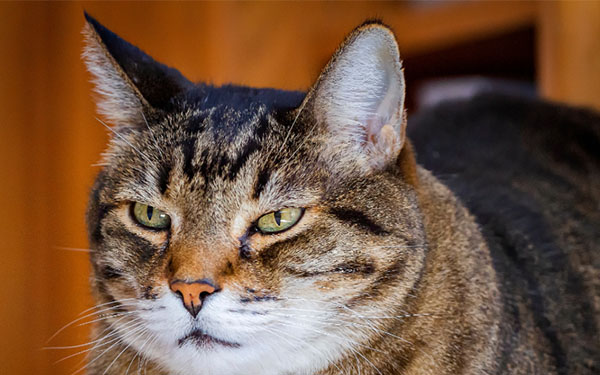
“There’s a lot of controversy about whether animals age differently,” said Dr. Christine Charvet, assistant professor of neuroscience in Auburn’s College of Veterinary Medicine. “There’s some description of brain atrophy in animals, but it’s not very extensive. We were really surprised to see so much atrophy in cats, and it really mirrored the pattern we see in humans.”
At the center of study is a framework known as “Translating Time,” which aligns biological milestones and aging markers across various species. Rather than simply comparing ages by years, Translating Time accounts for the pace at which different species develop and age, providing a more accurate and detailed biology-based picture. The brain age of a 15-year-old housecat, for example, equates to that of an 80-year-old human.
“When we want to find a model system to study aging or Alzheimer’s, we need to study them at the right age,” Charvet said. “That’s how we became interested in felines. We have wanted to translate time in humans and cats for a very long time Developing the right approach was challenging.”
A shared pattern of brain aging
Using advanced MRI imaging, Charvet and her colleagues noted that cats and humans experience gradual brain shrinkage as they get older. At the same time, fluid-filled spaces in the brain expand, representing one of the hallmarks of aging frequently associated with cognitive declines in humans.
Charvet said that the stereotypical “pampered housecat” offers an ideal model for understanding aging in humans because of similar biological processes at work. Many animals found in traditional research settings do not reach equivalent life stages of humans. Mice, for example, age quickly and rarely exhibit the full range of late-life change seen in people. Cats bridge the gap, making them uniquely suited for studying age-related conditions, including brain changes associated with Alzheimer’s.
“When we look to human brains and we study them at different ages – 50, 60, 70 – we really see that shrinking comes with age,” she said. “And the cat brains are also shrinking with age. When cats get old, they develop plaques and tangles [in their brains].
“There’s a point in time when the brain is maximal in size in the cats. And there’s a point in time when that also happens in the human brain. We can compare these two time points.”
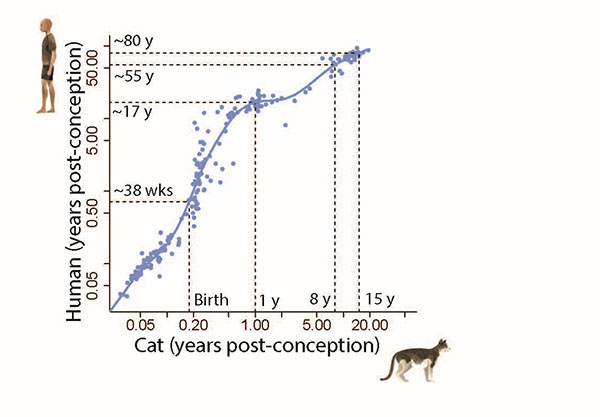
Corresponding time points used to generate age alignments across humans and felines.
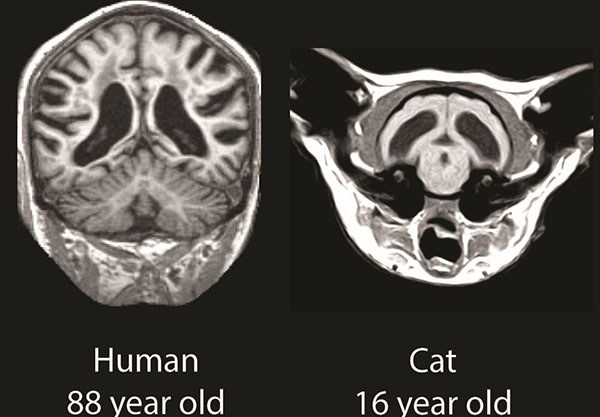
Front sections taken from non-invasive MR brain scans of a human and a cat, respectively.
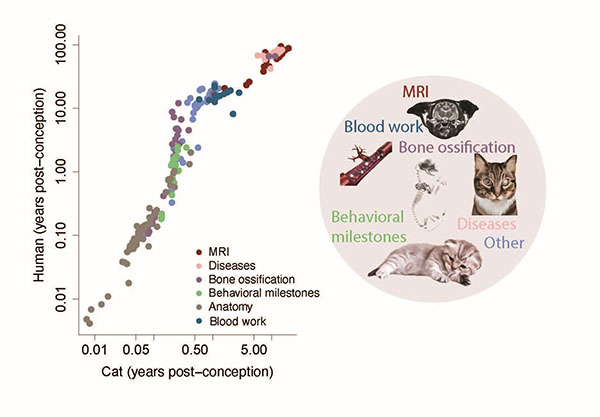
Corresponding time points used to generate age alignments across humans and cats are color-coded accorind to the process. Some exampes of these processes are shown to the right.
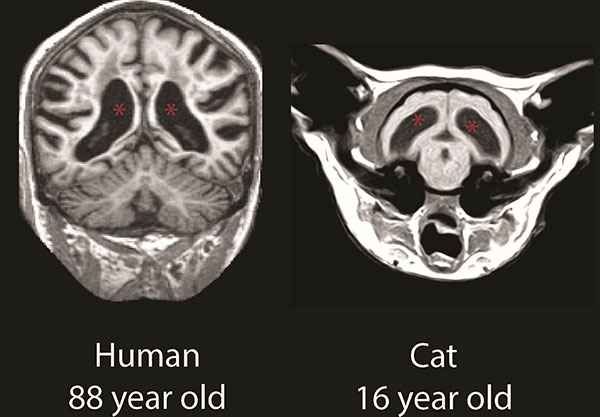
Front sections from non-invasive MR brain scans of humans and cats are marked with red asterisks to show enlarged ventricles in each.
A building block for future ‘One Health’ research
In addition to including Auburn faculty members Ryan Gibson and Amanda Gross, Charvet’s research team also engaged research fellows Capucine Januel (who visited Auburn from École Nationale Vétérinaire de Toulouse) and Alexandra de Sousa (Auburn), as well as doctoral candidates Eli Morrow (Auburn) and Brier Rigby Dames, who visited Auburn from University of Bath.
By combining the Translating Time approach with real world clinical data, the study reinforces the “One Health” interconnectivity between human and animal health. Findings could serve as an important building block for improving care for pets and preventing or treating age-related diseases in humans.
“One of the most important takeaways for cat owners and enthusiasts is that our understanding of cat husbandry and care continues to improve, which has led to cats living longer than ever before,” said Morrow, who is pursuing a Doctor of Veterinary Medicine as well as a doctorate in Biomedical Sciences. “With advances in veterinary medicine, including improved diagnostic and treatment options, we are now seeing cats reach ages comparable to human octogenarians. Because of this increased longevity, it’s important for cat owners to recognize how valuable their pets’ medical records and overall health history can be to research efforts like this project.”
The implications of their work range far beyond veterinary medicine. There is ample room to examine interplay between such elements as nutrition, exercise/play, rest and brain aging.
“It is for sure a first step,” said Gibson, assistant clinical professor of neurology in Auburn’s College of Veterinary Medicine. “We know very little about cognitive decline in cats compared to humans and dogs.
“A study like this can get others excited about further diving into cognitive changes in cats.”
Research