
Search Results
Cora – American Kestrel Cora, an American Kestrel, joined the Auburn University Raptor Center in 2023 after being taken from the wild by a family who believed she would make a good pet. Like all native raptors, American Kestrels are protected by federal law, and removing them from the wild is both illegal and harmful. After realizing that […]
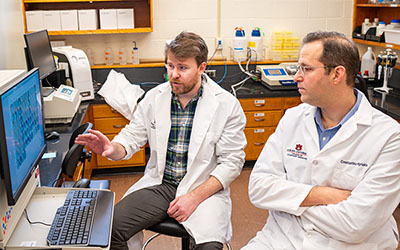
Researchers study swine immunity to unlock better flu vaccines
Since September 2025, more than 24 million Americans have come down with the flu. Most of those cases were caused by a highly mutated version of influenza A, the H3N2 K subclade, that showed up last summer, long after the strains of flu used to formulate this year’s flu shot were chosen.
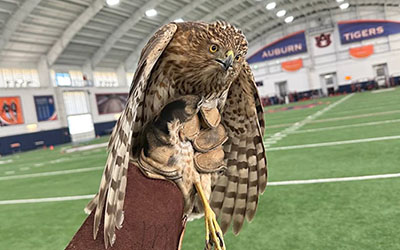
The hawk who wanted to be a Tiger
The Auburn University Raptor Center helped the Auburn football program deal with an unexpected walk-on — or fly-in — recruit who bypassed college football’s transfer portal and traditional recruiting processes. In early February, a Cooper’s hawk found its way inside the football team’s indoor practice facility but couldn’t find its way out.
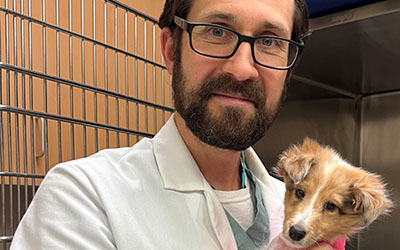
Tiny puppy, big heart: Blondie’s second chance receives boost from Auburn University donors
Blondie, a 2-month-old Shetland Sheepdog puppy, recently came to Auburn University’s Bailey Small Animal Teaching Hospital with a common but serious congenital heart defect — patent ductus arteriosus (PDA). If left untreated, the condition can significantly shorten a dog’s lifespan. Thanks to the work of the College of Veterinary Medicine’s Cardiology Service team and the generosity of Auburn University Tiger Giving Day donors, Blondie should live a long, healthy and happy life.
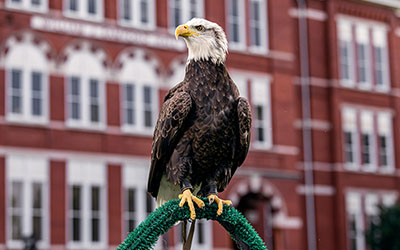
A Silent Threat: Protecting Bald Eagles from Lead in Our Community
At the Auburn University Raptor Center, we’re fortunate to spend every day working with some of the most iconic birds in North America both on our rehabilitation side and also with our Education Ambassadors.
A pocket-sized tool with life-saving potential for horses
When a horse becomes suddenly and severely ill, time seems to tighten around each potential decision. A fever. Rapid breathing. An elevated heart rate. Gums taking on a dark red coloration from increased blood flow. For veterinarians and horse owners, these early warning signs point to sepsis, a potentially life-threatening condition that can result from pneumonia, post-partum complications, abscesses, gastrointestinal issues and other health problems.
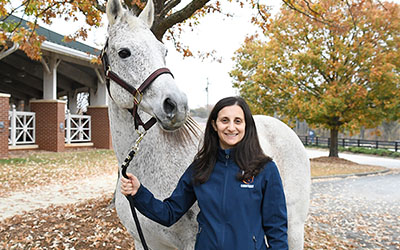
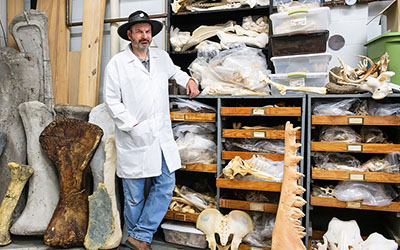
Ray Wilhite’s office at Auburn University is a cabinet of curiosities — a place where ancient bones, thank-you notes and a signature Australian cowboy hat all tell the story of a scientist, teacher and mentor whose passion for anatomy and paleontology is matched only by his devotion to students. For 18 years, Wilhite has served as both anatomy laboratory coordinator for the College of Veterinary Medicine and curator of vertebrate paleontology at the Auburn University Museum of Natural History.
Molecular messengers: Decoding a circulatory threat
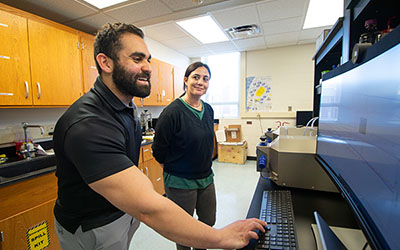
Peripheral artery disease (PAD) doesn’t typically announce itself in the form of a stroke or heart attack. The signals are far more subtle – feeling the need to rest while climbing a flight of stairs, experiencing a tightening in the calf muscles while taking a walk or a creeping sensation that normal movement is beginning to slip away.
Public and One Health student turns curiosity into impact
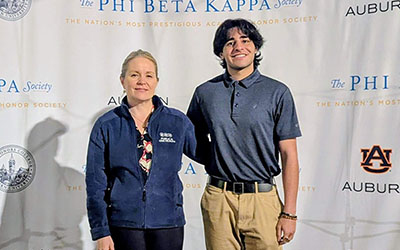
While Auburn University’s Public and One Health (PAOH) undergraduate program has been in existence for just over a year, the major tends to attract a very specific type of student. “They’re systems thinkers, they’re curious, they’re driven, and they’re drawn to complex problems,” said Dr. Kelley Steury, co-director of the PAOH program and assistant clinical professor in the College of Veterinary Medicine’s Department of Pathobiology.
Global perspectives: Cottingham selected for NCURA fellowship
As the College of Veterinary Medicine’s Director of Research Program Development, Contract & Grant Administration, Erika Cottingham enjoys working “at the center of ideas, people, and systems.” “The college’s research portfolio is broad, ambitious, and impactful,” she said, “and my work allows me to support that mission by helping faculty and leadership navigate the structures that make funded research possible.”
