Search Results
Roots in horse capital inspire Auburn DVM student
In and around Figueroa’s hometown of Ocala, Florida, more than 1,200 horse farms feature over 50 breeds. While Marion County’s sprawling green pastures are known for producing thoroughbreds, including six Kentucky Derby winners and 26 Breeders’ Cup champions, Figueroa focused on a breed descended from Andalusian, Spanish Barb and Spanish Jennet horses imported by Christopher Columbus over 500 years ago.
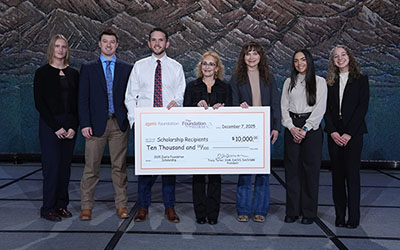
CVM to create professorship focusing on feline, canine nutrition
Auburn University’s College of Veterinary Medicine is among five leading veterinary colleges nationwide to receive donations from Purina aimed at advancing scientific and nutritional breakthroughs in pet health.

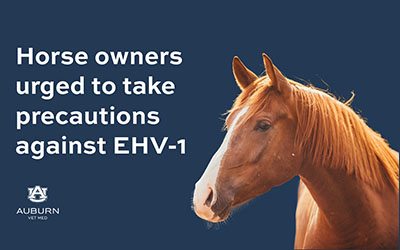
Horse owners urged to take precautions against EHV-1
Auburn University’s College of Veterinary Medicine is closely monitoring the recent and ongoing outbreak of Equine Herpesvirus (EHV-1) in Texas, Oklahoma and Louisiana. While no cases of EHV-1 have been reported in Alabama at this time, EHV-1 is highly contagious and is primarily spread though horse-to-horse contact via respiratory secretions, aerosolized droplets or indirect contact with contaminated equipment, feed, tack, water buckets and human hands or clothing.
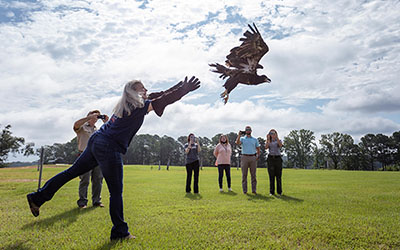
From rescue to release: Raptor Center manages growing caseload of injured and ill birds of prey
They have arrived from all corners of Alabama, in all manner of containers. Turkey vultures wrapped in blankets and towels, burrito-style; bald eagles and hawks caged within pet carriers. Auburn University Raptor Center (AURC) Director Robyn Miller even remembers a golden eagle with lead toxicity being delivered to the center in a pair of taped-together packing boxes [the AURC offers preferable guidance on how Good Samaritans can transport a wild bird that is injured or ill].
CVM opens doors to future veterinary technicians
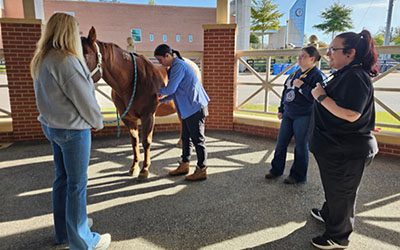
In October, the CVM welcomed nine students and two instructors from Jefferson State Community College for a large animal lab focused on equine and bovine care. Hosted twice a year by the college, the lab is part of a collaborative effort led by Chief Veterinary Nursing Officer Erin Allen, Veterinary Nurse Training Manager Stephanie Mitchell, Large Animal Research Coordinator Jessica Brown and Dairy & Herd Manager Simon Taylor.
CVM welcomes Narayanan as Pathobiology department head
Auburn University’s College of Veterinary Medicine welcomed Dr. Sanjeev Narayanan as its new head of the Department of Pathobiology in October. Narayanan joins the college from Purdue University, where he had served as professor and head of the Department of Comparative Pathobiology since 2017. He also held the position of interim associate dean for research and graduate studies in the College of Veterinary Medicine from 2024-2025. Narayanan led college-level initiatives in artificial intelligence in education and served as an academic lead for Purdue Online.

Going the distance: HumaneVMA scholarship represents milestone on Johnson’s professional journey
In each of the last two years, Johnson, a veterinary assistant in the Auburn University College of Veterinary Medicine’s shelter medicine program, laced up her running shoes to help raise money for Chicago’s Anti-Cruelty animal shelter. She tackled the Chicago Half Marathon in 2024 (her first 13.1-mile race) and chased it with her first 26.2-mile test of endurance at the 2025 Bank of America Chicago Marathon.
Passion for endangered species propels Auburn DVM student to Smithsonian externship
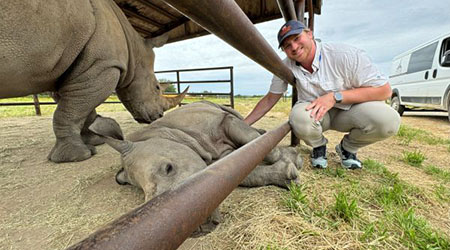
When Eli Morrow hung up his helmet, cleats and shoulder pads after playing football at the University of Utah, he had initially expected his educational and professional journey to continue with medical school. Instead, his attention shifted to cheetahs, red pandas, rhinos, black-footed ferrets, and other exotic and endangered species.
Tick Threat Tackled: Auburn faculty member wired into tick research
“Ticks are an omnipresent threat, and they’ve been around for millions of years, since before the time of the dinosaurs,” said Reif. “Many of the most common tick species are equal opportunity biters, so they can be a problem for pets and livestock animals as well as people. They also can carry serious diseases such as ehrlichiosis, Lyme disease and Rocky Mountain spotted fever.”

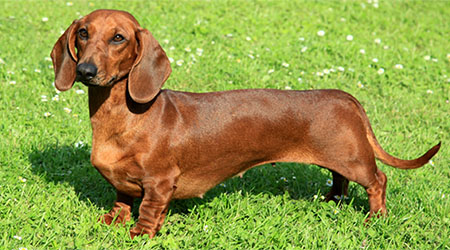
From lab to leash: Sullivan’s genetic research offers hope for ending dachshunds’ spinal struggles
Dachshund breeders and owners have long faced a painful reality. The beloved breed’s signature short legs can come with an elevated risk of painful and debilitating spinal disease.