
A pocket-sized tool with life-saving potential for horses

When a horse becomes suddenly and severely ill, time seems to tighten around each potential decision.
A fever. Rapid breathing. An elevated heart rate. Gums taking on a dark red coloration from increased blood flow.
For veterinarians and horse owners, these early warning signs point to sepsis, a potentially life-threatening condition that can result from pneumonia, post-partum complications, abscesses, gastrointestinal issues and other health problems. Organ failure or death can result within a matter of hours or days, placing a premium on quick diagnosis and rapid treatment.
Dr. Serena Ceriotti, an assistant professor in large animal emergency and critical care in the Department of Clinical Sciences, has made it her mission to help improve the detection, monitoring and treatment of equine sepsis.
“There are so many markers, so many signals, which have been measured to try detecting sepsis in people, in horses, in all species,” she said. “The problem is how reliably and how fast you can have that result and how cheap that it can be.”
Thanks to a Young Investigator Research Grant awarded by The Foundation for the Horse and the Thoroughbred Education and Research Foundation, Ceriotti will have ample support to seek solutions to those challenges. Her research project, “Cell-free hemoglobin in septic adult horses,” addresses the challenges involved in detecting sepsis in its preliminary stages.
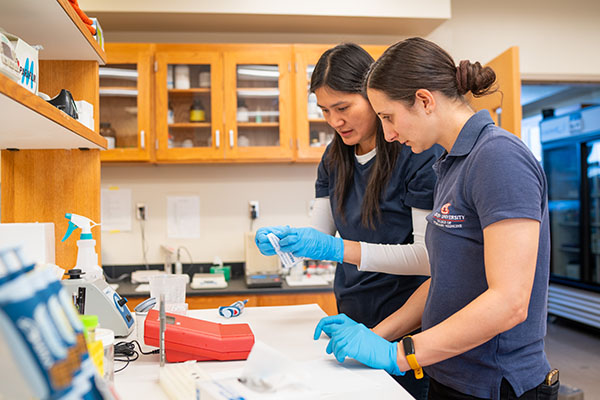
Because sepsis affects the body in so many ways, confirming its presence can involve multiple tests. For horses, that frequently entails specialized – and potentially costly – lab equipment. Ceriotti’s investigation focuses on the use of a simple, dependable and easily portable tool that holds the promise of early detection.
A clue hidden in the bloodstream
Ceriotti’s study involves cell-free hemoglobin (CFH), a substance that leaks into the bloodstream when red blood cells break down during sepsis and other illnesses. Elevated levels of CFH are associated with more severe health outcomes in human and canine patients. One prior study showed that horses with intestinal disease had higher levels of CFH than healthy ones, indicating that CFH can offer a useful marker for tracking sepsis in horses.
“CFH is a signal that your body would release when it’s threatened by infection in a severe way,” Ceriotti said.
For hospitalized human patients, a handheld device the approximate size of a glucose meter can measure CFH in a matter of seconds. That same technology can be a game-changer for horses, Ceriotti said, by offering an affordable and time-efficient tool for clinical or field settings.
“It can be used stall-side,” Ceriotti said. “I think that’s why The Foundation for the Horse liked the project, because it’s really applicable to practitioners.”
From conference curiosity to equine innovation
The inspiration for Ceriotti’s project came from an unexpected place – a human medical conference hosted by the American Thoracic Society. Ceriotti attended a presentation about a clinical trial examining the effects of the common, over-the-counter remedy acetaminophen in critically ill patients recovering from sepsis.
“I got curious,” she said. “Tylenol is a drug that’s commonly used in horses as well. It’s cheap and easy to give.”
If Tylenol can help reduce CFH-related damage in humans, she reasoned, couldn’t the same be true for horses? The answer has been unclear due to a lack of research. She found one “relatively old” study published in German that used complex laboratory methodology.
Ceriotti’s study will compare CFH levels in health, sick and septic horses using both standard lab tests and the quick, portable device stall-side. One goal will be to determine whether the rapid test is more accurate than the standard lab test and whether CFH can truly serve as a reliable warning signal.
“CFH is sort of an alarm that will go off,” Ceriotti said. “Measuring it over time can help us tell whether we’re doing an effective job in treating the horse.”
If successful, her research could equip veterinarians with a “practical tool to make medical decisions” at the point of care, guided by real-time information.
“The earlier the treatment, the more effective and cheaper it can be,” Ceriotti said. “Even if I save one [horse], that makes a lot of difference to me.”