
Public and One Health student turns curiosity into impact
By Troy Johnson
While Auburn University’s Public and One Health (PAOH) undergraduate program has been in existence for just over a year, the major tends to attract a very specific type of student.
“They’re systems thinkers, they’re curious, they’re driven, and they’re drawn to complex problems,” said Dr. Kelley Steury, co-director of the PAOH program and assistant clinical professor in the College of Veterinary Medicine’s Department of Pathobiology.
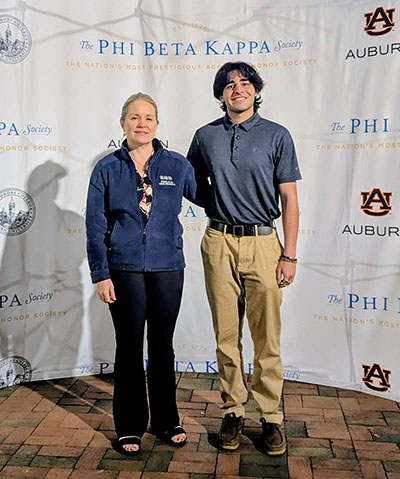
Chris Khalaf, a senior PAOH major from Vestavia Hills, Alabama, serves as a prime example of what the fast-growing program seeks to develop — critical and creative thinkers who understand that the solutions to public health challenges are often found in addressing the social, economic, biological and environmental factors that form their root systems. In Khalaf’s case, his early curiosity about rural health care and food insecurity helped him define his goal of pursuing a law degree and applying his talents at the intersection of public health, food access and public policy.
“My interest began in rural clinics and food pantries, where I saw families struggle not because they lacked effort but because the systems meant to support them were confusing and hard to reach,” said Khalaf, who also plans to pursue a Master of Public Health degree. “Through my work on food systems research, SNAP (Supplemental Nutrition Assistance Program) access and natural resource economics and environmental policy, I learned how deeply laws shape the realities people face every day. My goal is to use the law to build a food system that is fair, practical, resilient and reliable for every family.”
Moving mountains to improve public health outcomes
Khalaf found educational and professional inspiration in Tracy Kidder’s book Mountains Beyond Mountains: The Quest of Dr. Paul Farmer, A Man Who Would Cure the World. The biography traces Farmer’s life as a physician and anthropologist who devoted much of his professional life to community-based healthcare in impoverished nations around the globe. Farmer, the co-founder of Partners in Health, worked to mitigate the effects of HIV in Haiti and to confront drug-resistant tuberculosis in Peru and Russia.
“That book drew me to Auburn’s Public and One Health program,” Khalaf said. “Once I learned about Auburn’s partnership with the Alabama Rural Health Initiative, I felt compelled to apply Dr. Farmer’s model with a uniquely Southern perspective.”
In 2024, as a fellow with the Auburn University Rural Health Initiative (AURHI), Khalaf developed micro food pantries at the Chambers County Community Health and Wellness Center to fight food insecurity and offer hygiene products to clinic users. He also established partnerships with the Food Bank of East Alabama and Inspire Academy, a vocational and technical school in LaFayette, Alabama, to secure ongoing nonperishable food donations and implemented a storage distribution system to minimize potential food waste.
According to the Alabama Department of Public Health, the state is the fifth poorest nationally with 23% of children and 17% of adults facing food insecurity or lack of regular access to enough nutritious food to support a healthy lifestyle. Low-income families may face the difficult choice of covering the electricity bill, rent or mortgage payments before buying groceries. Located a little more than 30 minutes from Auburn’s campus, Chambers County grapples with many of the same food insecurity challenges as its other rural counterparts around the state. According to U.S. Census Bureau data, more than 20% of the county’s residents receive SNAP benefits and an estimated 15.5% of residents live below the poverty level.
“I learned that tackling food insecurity extends beyond filling someone’s plate,” Khalaf said. “It involves economic development, policymaking, health care mobilization, and much more.”
Khalaf, who was recently inducted into AU’s chapter of Phi Beta Kappa, the nation’s oldest and most selective academic honor society, certainly maintains a full plate when it comes to serving others. In addition to his experience with AURHI, he also been active in Students for Clean Water, Pi Lambda Sigma Pre-Law Honor Society and Campus Kitchens, which fights food waste and hunger by recovering excess food from on-campus dining halls. In 2024, he was also selected as one of 12 fellows for E Pluribus Unum, a foundation that focuses on social fragmentation, economic exclusion and lack of trust in institutions across the South.
Dr. Ramandeep Kaur, One Health lecturer in the College of Veterinary, said Khalaf’s engagement in classes, combined with the creativity and resourcefulness he demonstrated through his work in Chambers County, speaks to his “intellectual maturity, curiosity, and ability to think critically.”
“That kind of initiative – thinking across systems, collaborating effectively, and turning ideas into tangible results – is rare,” Kaur said. “It’s clear he genuinely cares about improving population health. He embodies the innovative thinking, community focus, and global perspective that the PAOH program values.”
Fostering big picture thinking
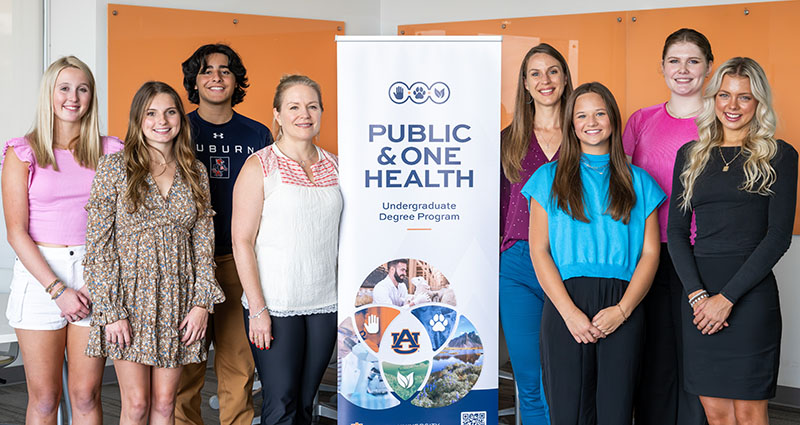
Even though Auburn’s PAOH program is housed within the College of Veterinary Medicine, the undergraduate major offers a variety of potential pathways for students who are interested in the broader concept of “One Health,” which examines the interconnectivity between humans, animals and the environment and offers a holistic approach for the development and implementation of solutions to local and global health issues. Students may have an interest in natural or social sciences or aspire to pursue advanced degrees, attend a professional school (medical, veterinary, law, etc.) or work in research or public policy settings after graduation.
“Students who thrive in PAOH are those who enjoy complexity – students who want to understand why problems exist, who they affect, and how solutions can be implemented in the real world,” Steury said. “They are not satisfied with simple explanations. They think across disciplines, often naturally drawing connections between policy, environment, economics, community needs and health outcomes.
“Chris exemplifies this. He doesn’t just look at a health issue in isolation; he naturally considers the biological, environmental, economic and or social factors that shape it. This ‘big picture’ thinking is exactly what PAOH aims to cultivate.”
Khalaf said his educational journey has offered constant reminders that “curiosity, integrity and a commitment to learning can open doors that once felt far away.”
In his case, the learning process will ultimately lead to a career devoted to opening doors for others.
“The PAOH program will help me grow into the public health leader I hope to become,” he said. “It will give me a deeper understanding of how health challenges take shape in real communities and how to work alongside those communities to create solutions that last.”